By alphacardprocess February 7, 2026
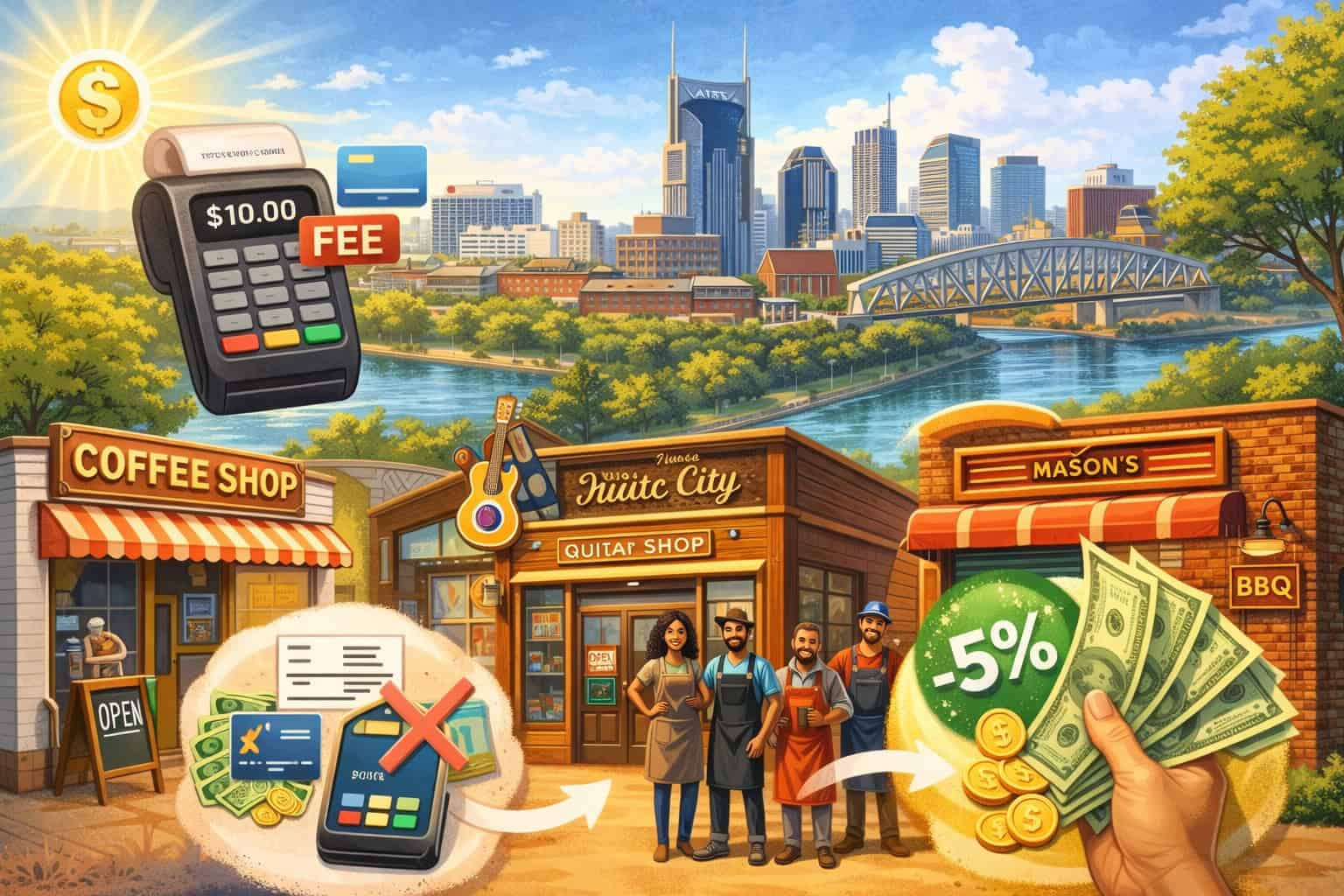
Running a small business in Nashville means living with tight margins, fast-moving customer demand, and a steady stream of operating costs that never seem to slow down.
One of the most frustrating costs is card processing—those percentage-based fees that quietly eat into every ticket, whether you run a coffee shop in East Nashville, a boutique in 12 South, a food truck near a weekend event, or a service business that invoices clients across the city.
That’s where cash discount programs come in. When implemented correctly, cash discount programs can help you reduce—sometimes nearly eliminate—processing fees by encouraging customers to pay with cash (or other lower-cost methods) through transparent, compliant pricing.
The key is doing it the right way: with correct price presentation, clear signage, staff scripts that don’t annoy customers, point-of-sale setup that matches card-brand rules, and a plan that fits Nashville’s unique mix of locals, tourists, venues, and high-volume weekends.
This guide is designed to be practical and readable, while still being detailed enough to help you make decisions with confidence. You’ll learn how cash discount programs work, what compliance really means, how to roll one out without damaging customer trust, and how to predict where fee-recovery models are headed next.
What a Cash Discount Program Really Is (And Why It’s Not the Same as a Surcharge)
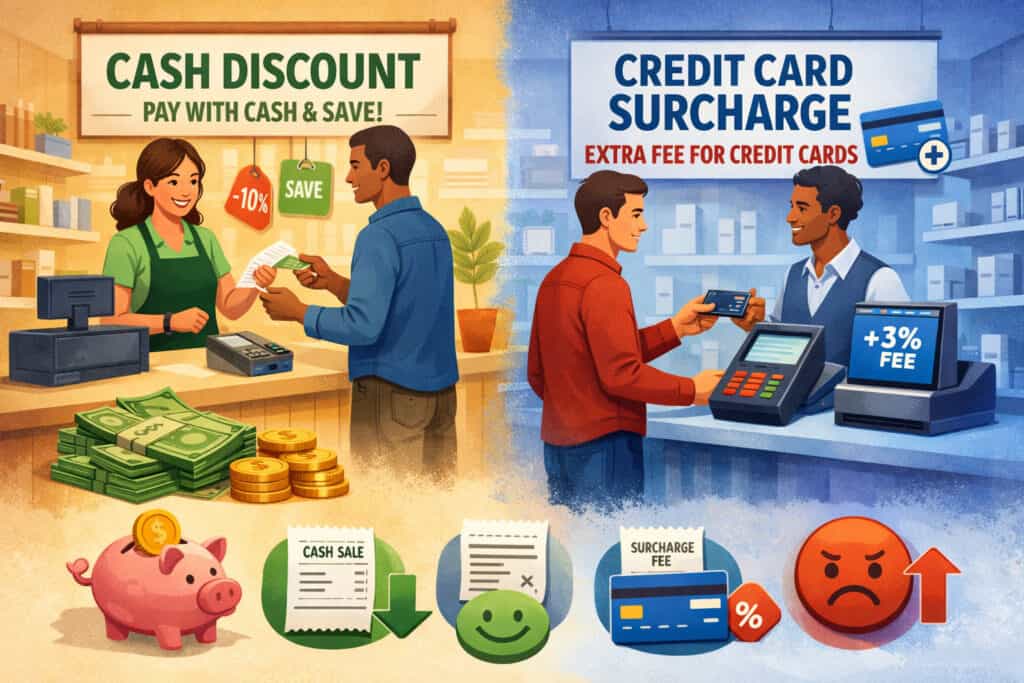
A cash discount program is a pricing approach where your standard posted price is the card price, and customers receive a discount when they pay with cash (or another qualifying method).
In other words, you’re not “adding a fee” to card users; you’re offering a discount to cash payers. That distinction sounds small, but it’s huge in practice—because it changes how you display prices, how receipts look, and how card networks interpret your checkout flow.
Card brands generally allow merchants to offer a discount for paying with an alternative method instead of a card. Visa specifically recognizes “cash discount” as a discount offer, but emphasizes that to do it correctly, merchants must display pricing in permitted ways (such as showing only the card price, or showing both card and cash prices side-by-side) and must not achieve the card total by adding a separate fee at checkout, which may be treated as a surcharge.
A surcharge, on the other hand, is an additional amount charged specifically for paying with a credit card. Surcharging can be legal in many places, but it typically comes with stricter rules, extra notice requirements, different receipt requirements, and more risk if executed improperly.
Visa also states that surcharging can only apply to credit cards—not debit or prepaid—and outlines enforcement and fines for improper surcharging.
For Nashville small businesses, cash discount programs are often the simpler, lower-friction path because they can be structured around discounting rather than “fees.” When customers feel like they’re receiving a benefit (a discount) instead of being penalized (a fee), your program is more likely to be accepted and less likely to trigger complaints.
To be clear: cash discount programs are not “magic” and they aren’t “free money.” They are a pricing strategy. If you choose to use cash discount programs, you’re choosing to redesign how you present prices so that your business recovers more of the cost of card acceptance, while offering customers a legitimate discount option.
Why Processing Fees Hurt Nashville Businesses More Than You Think
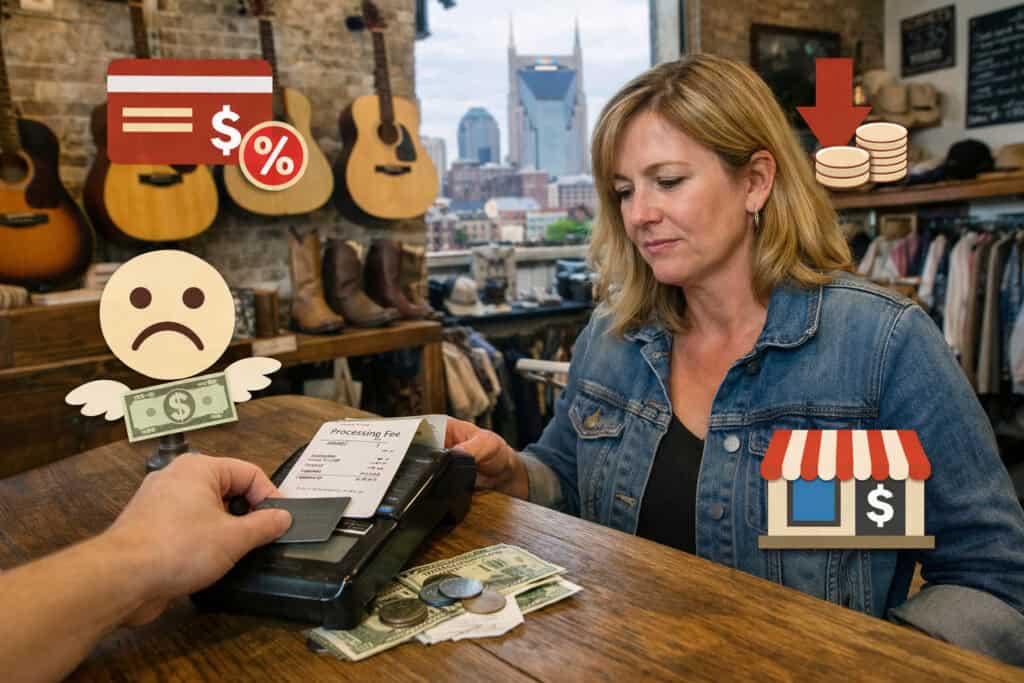
Processing fees don’t just reduce profit. They shape your ability to hire, invest in marketing, upgrade equipment, and survive slower months. In a city like Nashville, seasonality can be real.
Some businesses get slammed during peak tourism, festival weekends, and event seasons, but experience softer days mid-week or off-season. When ticket volume changes, processing fees scale with sales—meaning the “good” months still carry a built-in cost that grows as you grow.
Restaurants, bars, coffee shops, quick-service counters, and entertainment-adjacent retail often feel this most sharply because of high transaction counts and smaller average tickets. On a $7 coffee order, a percentage fee plus a per-transaction charge can feel disproportionately painful.
Meanwhile, service providers—salons, repair services, home services, consultants—may face higher ticket sizes and more keyed-in transactions, which can carry different cost profiles.
Cash discount programs can relieve pressure in two ways. First, they can offset processing expense by shifting some payments to cash. Second, they can stabilize your effective margins by making your price structure less vulnerable to fee fluctuations. Even small changes—like moving a portion of customers to cash—can add up over thousands of transactions.
In Nashville specifically, many businesses serve a mix of locals and visitors. Visitors often default to card and mobile wallets. Locals may be more receptive to a discount if it’s clearly communicated.
A well-designed cash discount program can work in both scenarios, but only if it’s presented as a normal, transparent part of your pricing—no surprises at the register, and no awkward “gotcha” moment when the customer is ready to pay.
The Core Principle That Keeps Cash Discount Programs Compliant
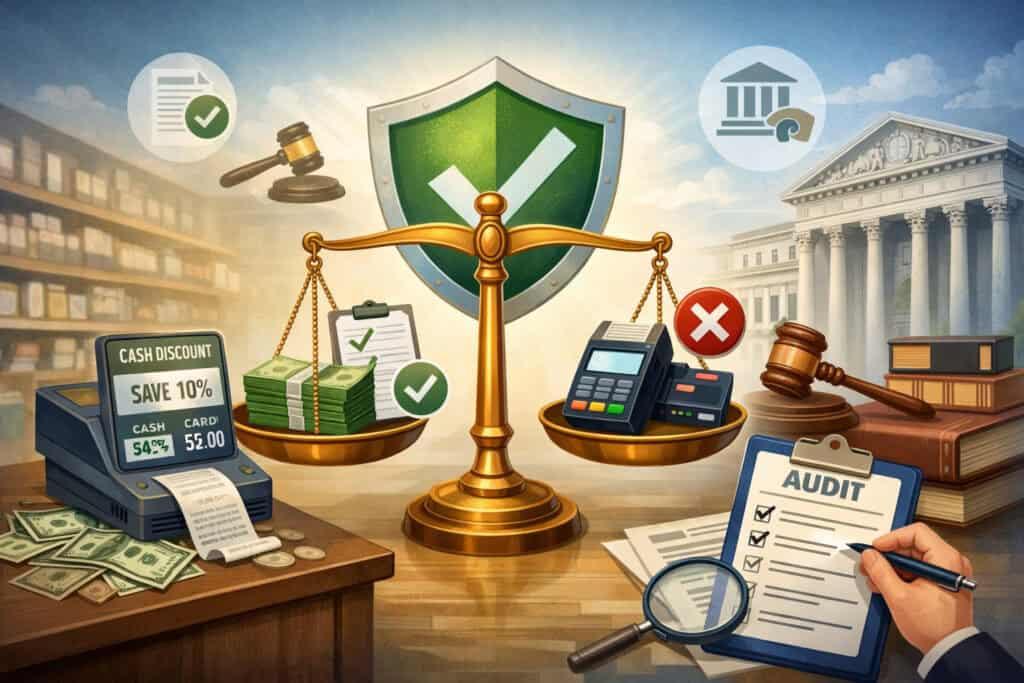
The compliance “secret” behind cash discount programs is simple:
Your posted price must be the card price, and the cash price must be presented as a discount from that posted price.
Visa’s guidance highlights that merchants can offer a cash discount when presented properly—either by displaying only the card price or by listing both card and cash prices side-by-side—and warns that producing the card total by applying an added fee at checkout may be treated as a surcharge.
This is where many merchants accidentally drift into non-compliance. A common mistake is posting a “cash price” everywhere, then adding a line item like “non-cash adjustment” at checkout. Even if your intent is a discount model, that execution can look like a surcharge model—because the customer experiences it as an added fee.
Another important compliance anchor: debit cards are treated differently than credit cards in the surcharge world. Visa states that merchants cannot surcharge Visa debit or prepaid cards. NFIB’s legal guide also underscores that debit surcharging is prohibited under federal law, while cash discounts are generally permitted if disclosed clearly.
That’s why many modern cash discount programs are designed so that:
- the business posts the card price,
- the discount applies for cash,
- and the system avoids any prohibited “debit surcharge” behavior.
If you remember nothing else, remember this: cash discount programs live or die by price presentation and customer disclosure. Get those right and everything else becomes manageable.
Cash Discount Programs vs Dual Pricing vs Surcharging: Which Model Fits Your Business?
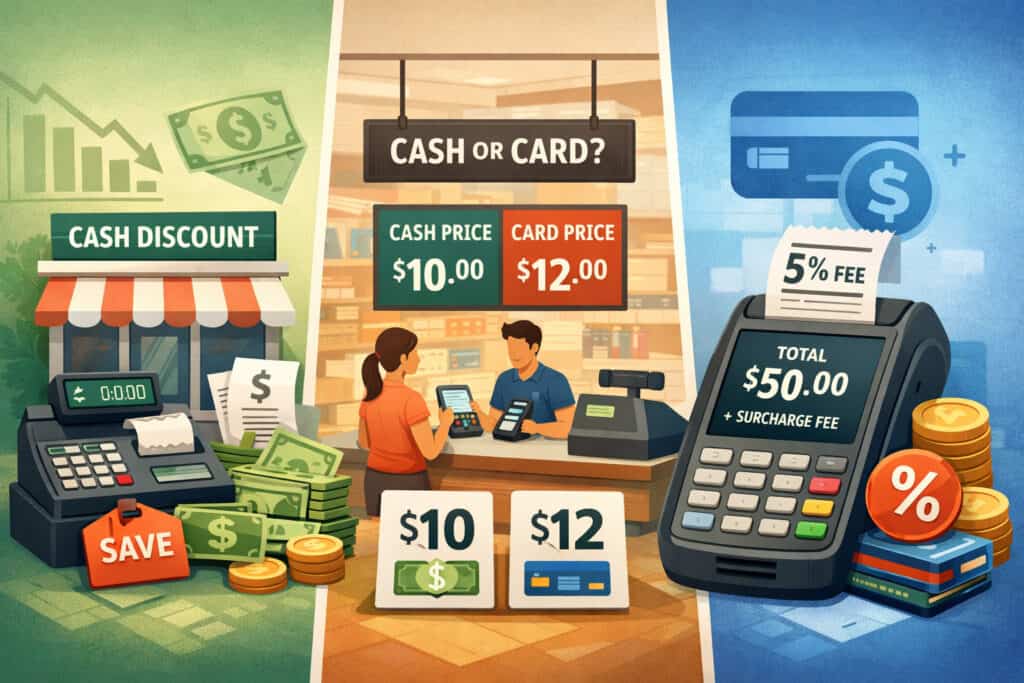
Nashville businesses often hear these terms used interchangeably, but they aren’t the same. Choosing the right model matters because the “wrong fit” can create customer friction, compliance risk, or messy bookkeeping.
Cash Discount Programs
Cash discount programs revolve around a posted card price with a cash discount applied. This model is often attractive to consumer-facing businesses because the story is positive: “pay with cash and save.” It can be easier for staff to explain, especially in fast-paced environments like coffee counters or food service.
A big advantage is that cash discount programs can be structured to feel like a promotion rather than a penalty. That usually reduces complaints. But the model requires you to be disciplined about price displays, signage, and receipt language.
Dual Pricing
Dual pricing is a more explicit version of cash discount programs where you display two prices for the same item: a card price and a cash price. This can be incredibly clear for customers because it removes the mystery. If your menu, shelf tags, or signage show both prices, customers understand the choice before they order.
Dual pricing can be especially effective in Nashville’s tourist-heavy zones because visitors can decide quickly without needing a long explanation. It can also reduce negative reviews because customers feel informed.
Surcharging
Surcharging adds a fee to credit card transactions, and it tends to be more tightly regulated by card-brand rules and disclosure obligations. Visa’s surcharge Q&A notes disclosure and receipt requirements, limits on surcharge amounts, and enforcement practices. NFIB also summarizes common surcharge requirements such as disclosures and that debit cannot be surcharged.
For some industries, surcharging can still be a fit. But for many Nashville small businesses focused on customer experience, cash discount programs or dual pricing are often the smoother route—especially when speed, simplicity, and repeat business matter.
Which Nashville Business Types Benefit Most From Cash Discount Programs
Not every business will love cash discount programs. But many will. The best candidates tend to share a few traits: consistent foot traffic, lots of small-to-mid tickets, and customers who can easily choose between cash and card without needing financing or rewards points.
Restaurants, Cafés, Bars, and Quick-Service Counters
These businesses often see large transaction volumes. Cash discount programs can produce meaningful savings quickly if even a small portion of customers switch to cash. In busy Nashville service settings, the program must be simple: clear signage, fast POS behavior, and staff who can explain it in one sentence.
Retail Shops and Boutiques
Retail can do extremely well with dual pricing-style cash discount programs because item pricing is visible. The key is presenting the card price and showing the cash discount clearly at the register and, ideally, on shelf tags for high-frequency items.
Salons, Spas, and Personal Services
These businesses often have regulars. Regular customers are more likely to adapt to cash discount programs over time, especially if the savings are consistent and explained politely. The biggest challenge is ensuring the program doesn’t feel awkward at the end of an appointment.
Home Services and Invoice-Based Businesses
For businesses that bill customers—repairs, cleaning, contracting—cash discount programs may apply differently. You can still offer a cash discount, but you’ll need a process for estimates, invoices, and payment links.
It’s also important to consider that many customers prefer cards for larger payments, so your “discount” may have to be meaningful without hurting your pricing structure.
In short, cash discount programs usually work best where the purchase decision is quick and the discount is easy to understand.
Step-by-Step: How to Implement Cash Discount Programs the Right Way
Rolling out cash discount programs isn’t just flipping a switch. Done well, it’s a controlled change-management process that protects your brand and keeps customers happy. Here’s a practical rollout path.
Step 1: Confirm Your Pricing Strategy and Discount Rate
Before touching your POS, decide what you’re actually trying to achieve. Are you trying to eliminate processing fees entirely, or reduce them? Many businesses target an offset that covers the bulk of typical processing cost. You want a rate that is defensible, consistent, and easy to explain.
This is also the moment to decide whether you will use:
- a pure cash discount model (posted card price, discount applied for cash), or
- dual pricing (show both prices up front).
Your decision affects your menus, shelf tags, website pricing, and customer messaging.
Step 2: Configure Your POS for Correct Price Presentation
The POS is where cash discount programs either become clean—or become risky. Your system should support proper price display and should not create the impression of an “added fee” that converts the experience into a surcharge model.
Visa’s guidance is explicit that the card total should reflect the displayed item totals and not be achieved by adding an extra fee at the end in a way that appears like a surcharge.
If your POS vendor or processor offers a “cash discount program” feature, ask exactly how it behaves:
- What price is shown on the customer-facing display?
- What prints on the receipt?
- How are refunds handled?
- Does the POS distinguish debit vs credit behavior correctly?
Step 3: Build Your Signage and Customer Disclosure Plan
Disclosures are not “nice to have.” They are the foundation of customer trust and a core compliance tool. NFIB’s guide emphasizes that cash discounts must be clearly and conspicuously disclosed.
Your signage should appear:
- at the entrance (where possible),
- at the point of sale,
- and anywhere a customer might otherwise be surprised (bar counters, mobile checkout areas, pop-up stands).
The best disclosure language is simple and positive. For example:
- “All prices reflect the card price. Pay with cash and receive a discount.”
- “Ask about our cash discount.”
Avoid language that sounds like a penalty.
Step 4: Train Staff to Explain It in One Breath
In Nashville’s fast-paced service environments, staff don’t have time for long explanations. Give them a script that’s friendly, short, and consistent, such as:
- “Just a heads-up—our posted prices are the card prices. If you pay with cash, you’ll get a discount.”
That’s it. No debate. No defensiveness.
Step 5: Soft-Launch and Monitor Customer Reactions
Consider piloting cash discount programs for a week before making big printing changes. Watch:
- customer questions at checkout,
- negative feedback patterns,
- refund or dispute issues,
- and staff comfort.
Then adjust. Often the fix is as simple as improving signage placement or clarifying one line on receipts.
Compliance Essentials for Cash Discount Programs in Tennessee
Even though cash discount programs are widely used, you should treat compliance as a serious part of implementation—especially because card-brand rules and consumer protection expectations tend to emphasize transparency.
NFIB’s 2025 guide includes Tennessee in a state-by-state chart and highlights that merchants must not hide differences between cash, credit, or debit prices and must clearly and prominently disclose the item price including additional fees prior to the sale. It also notes how cash discounts may be treated for certain state tax calculations in Tennessee contexts.
On the card-brand side, Visa emphasizes permissible ways to display cash discount pricing and the risk of being treated as a surcharge if the card total is created via an added fee at checkout.
If you want a practical “compliance checklist” for cash discount programs, focus on these pillars:
- Transparency: Customers should understand pricing before they pay.
- Price presentation: Posted pricing must align with your model (card price posted; cash discount clearly identified).
- Receipt clarity: Receipts should clearly show what happened.
- Debit handling: Avoid structures that can be interpreted as debit surcharging (especially important for networks that prohibit it).
Because laws and interpretations can evolve, and because every business model is different, treat this guide as implementation education—not legal advice. If you operate in regulated verticals or high-complaint environments, consult qualified counsel.
Signage, Receipts, and Price Displays: The Make-or-Break Details
Cash discount programs succeed when customers feel informed. They fail when customers feel tricked.
Signage That Prevents Checkout Shock
A customer should never learn about your pricing model at the exact moment they tap their card. That’s when emotions spike and complaints happen.
Place signage:
- where customers enter,
- where they order,
- and where they pay.
Use plain language. Avoid finance jargon. The more your sign reads like a legal document, the more customers suspect something is wrong.
Receipts That Match Your Story
Your receipt should reinforce the narrative: the customer saw the card price, then received a discount for cash—if they paid cash.
If your receipt instead shows an added “fee” for card usage, you’ve changed the emotional experience, and you may also create compliance risk if your execution resembles surcharging rather than discounting.
Menu Boards and Shelf Labels in High-Volume Nashville Locations
If you’re in a fast line environment—breakfast rush, lunch rush, late-night volume—customers read the menu quickly. Dual pricing can be a strong option in these cases, because it removes confusion.
If dual pricing is too heavy operationally, then keep posted prices as the card price and use very visible signage to highlight the discount for cash.
Visa’s Q&A explicitly recognizes side-by-side cash and card pricing as one permissible display method for discount offers. That’s a powerful tool if you want clarity without long explanations.
Customer Experience: How to Make Cash Discount Programs Feel Fair
In a city built on hospitality, vibes matter. Nashville customers—especially tourists—are sensitive to anything that feels like a “hidden fee.” The goal is to make cash discount programs feel like an optional savings opportunity, not a punishment.
Use Benefit-First Language
Lead with the discount:
- “Pay with cash and save.”
- “Cash discount available.”
Avoid fee-first language:
- “Card payments cost extra.”
- “Non-cash adjustment fee.”
Even if the math is similar, the psychology is completely different.
Don’t Argue With Customers
If someone complains, staff should have a calm response:
- “Totally understand. Our posted prices are the card prices, and cash gets a discount. You’re welcome to pay whichever way you prefer.”
Keep it short and respectful.
Align the Discount With Real-World Behavior
If your customer base is almost entirely card-based, a cash discount might not shift behavior much, and you may need a more visible incentive or a different approach (like ACH for invoices).
But many Nashville neighborhoods still have strong cash usage—especially in quick-service and nightlife settings—so cash discount programs can work well when paired with clear communication.
Accounting, Taxes, and Bookkeeping Considerations You Shouldn’t Ignore
Cash discount programs change how money moves through your business. If you don’t align bookkeeping early, you can create confusion later.
Revenue Reporting and Discount Tracking
In a true cash discount model, the posted price is the card price, and cash customers receive a discount. That means your system should track:
- gross sales at posted prices,
- discounts applied,
- tender types (cash vs card),
- and net collected.
This helps you analyze whether cash discount programs are actually shifting payment behavior.
Sales Tax and Price Presentation Discipline
Your taxable base can depend on your jurisdiction’s rules and how discounts are treated. NFIB’s guide includes notes about state-specific treatment and emphasizes transparent posted pricing and disclosure. Because tax treatment can be nuanced, many businesses rely on their POS tax configuration and accounting professional to confirm setup.
Refunds and Chargebacks
If a customer paid cash and received a discount, your refund policy and refund amount should be consistent. If you refund the card price when the customer paid the discounted cash price, you’ll create losses and disputes.
Build a written policy and train staff:
- how refunds work,
- what receipts show,
- and how to handle “I didn’t know” complaints.
Common Mistakes Nashville Businesses Make With Cash Discount Programs
Cash discount programs aren’t complicated, but small mistakes can cause big issues. Here are the most common failures.
Mistake 1: Posting a Cash Price and Adding a Fee for Cards
This is the classic error. Businesses want to advertise low prices, so they show the cash price everywhere and add a fee for cards.
The customer experiences it as a penalty, and card networks may interpret it as surcharging rather than discounting depending on execution. Visa warns that if the card total is achieved by applying an additional fee, it may be treated as a surcharge.
Mistake 2: Weak or Hidden Signage
If your sign is behind a tip jar or only appears on a tiny sticker by the terminal, customers won’t see it. Then your staff takes the hit.
Mistake 3: Inconsistent Staff Messaging
If one employee says “it’s a fee,” another says “it’s a discount,” and another shrugs, customers lose trust. Standardize the explanation.
Mistake 4: Messy Handling of Debit Cards
Debit rules differ from credit in surcharging contexts, and debit surcharging is widely prohibited. Visa explicitly states debit and prepaid cannot be surcharged. NFIB also flags that debit surcharges are prohibited under federal law. Even if you aren’t “surcharging,” sloppy implementation can create risk.
Mistake 5: Overpromising “Zero Fees” Without Explaining Reality
Some marketing around cash discount programs promises “eliminate all fees.” In real operations, results vary by customer payment mix, refunds, and program structure. Set expectations honestly: cash discount programs can dramatically reduce fees, and in some cases nearly eliminate them—but outcomes depend on your business.
How to Market Cash Discount Programs Without Turning Off Customers
Cash discount programs can be part of your brand story if you position them correctly.
Position It as a Local-Support Move
Nashville customers often respond well to community-first messaging. You can frame cash discount programs as a way to keep prices stable and invest back into staff, ingredients, quality, or local sourcing—without sounding dramatic.
Keep It Simple on Your Website and Social Media
A short FAQ on your site helps:
- “Do you offer a cash discount?” Yes.
- “Are your posted prices the card prices?” Yes.
- “How do I get the discount?” Pay with cash.
If you sell online, be extra careful with how pricing and disclosures appear on checkout pages. NFIB notes disclosure expectations can extend to online contexts for surcharge models; the broader lesson is that online customers also need upfront clarity.
Use In-Store Prompts Instead of Aggressive Announcements
Customers don’t need a speech. A simple sign plus a one-line staff script is usually enough. Let the discount speak for itself.
Technology Choices That Make Cash Discount Programs Easier
The smoother your tech, the smoother your program.
POS That Supports Clear Customer-Facing Display
In high-traffic Nashville locations, customer-facing screens reduce confusion. Customers can see the total and tender options without feeling surprised.
Receipts That Print the Discount Cleanly
Your receipt should clearly show:
- subtotal based on posted price,
- cash discount line (if applied),
- final total.
Avoid confusing labels that look like a junk fee.
Payment Acceptance Mix That Supports Alternatives
Cash discount programs work best when you also offer other low-cost options for certain customers, such as:
- ACH for invoices,
- bank transfer options for larger tickets,
- QR-based pay-by-bank (where available),
- or debit routing optimization in your processing setup.
You don’t have to push every option to every customer. Just build a toolkit so you aren’t relying on one approach.
Future Prediction: Where Cash Discount Programs and Fee-Recovery Models Are Headed
Cash discount programs are likely to keep growing, but they’ll evolve. Three trends are shaping what “best practice” will look like over the next few years.
Trend 1: Stronger Price-Transparency Expectations
Across industries, regulators and consumers are increasingly sensitive to “surprise fees.” Even when a pricing model is legal, businesses that surprise customers get punished through reviews and social media. The programs that survive will be the ones that embrace transparency—clear displays, clear wording, and no last-second surprises.
Trend 2: Card Networks Will Keep Enforcing Rules More Actively
Visa notes active enforcement and potential penalties for improper surcharging behavior. While cash discount programs are different from surcharging, the broader message is that networks care about how pricing is presented. Businesses should expect more scrutiny of confusing receipt language and checkout behavior.
Trend 3: More Alternatives to Traditional Card Payments
Real-time bank payments, pay-by-bank options, and account-to-account transfers continue to mature. As these options become more common, some Nashville businesses may pair cash discount programs with bank-based payment incentives for large invoices or memberships. That combination can reduce reliance on card rails and stabilize costs.
The bottom line prediction: cash discount programs will continue to work—especially for in-person retail and food service—but only the transparent, customer-friendly versions will thrive.
FAQs
Q.1: Are cash discount programs legal for businesses in Nashville?
Answer: Cash discount programs are generally permitted as a way to offer customers a discount for using cash instead of a card, provided the program is structured and disclosed correctly.
Visa explicitly recognizes “cash discount” as a discount offer and describes permissible price display methods such as showing only the card price or showing both card and cash prices side-by-side.
From a practical standpoint, the biggest risk isn’t the concept—it’s sloppy execution. If your checkout flow looks like you’re adding a fee to card transactions after advertising a lower price, that can create consumer complaints and may be treated as surcharging depending on how it’s implemented.
The safest approach is to keep your posted price aligned with the card price and present cash as a discount option, with signage visible before the customer pays.
Because legal interpretations can change and every business is different, especially for regulated industries, consult qualified legal guidance if you want a formal legal opinion.
Q.2: What’s the difference between a cash discount program and a “non-cash adjustment”?
Many people use “non-cash adjustment” as a label on receipts or signage, but the label alone doesn’t decide compliance. The real difference is how the pricing is structured and experienced.
In a true cash discount program, your posted prices reflect the card price and you apply a discount for cash. Visa warns that achieving the card total by applying an additional fee at checkout can be treated as a surcharge. That means if customers see a fee added after expecting a lower advertised price, you’re likely to create friction and potentially risk.
If you want to use the phrase “non-cash adjustment,” it should still align with a discount-based model in practice. In most consumer-facing Nashville businesses, using plain language like “cash discount available” is simpler and better for customer trust.
Q.3: Can I apply the same adjustment to debit cards?
Answer: Be careful here. Surcharging rules are strict about debit. Visa states that merchants cannot surcharge Visa debit or prepaid cards. NFIB’s guide also emphasizes that debit surcharges are prohibited under federal law.
Even if you’re running cash discount programs (not surcharging), your implementation should avoid anything that appears to penalize debit usage in a way that resembles prohibited debit surcharging.
This is why many merchants rely on properly designed cash discount programs that focus on discounting cash rather than adding fees.
Your processor or POS setup should clearly support compliant behavior. If your system can’t distinguish tender types correctly or produces confusing receipt language, consider changing the configuration before rollout.
Q.4: Will customers get angry if I use cash discount programs?
Answer: Customers usually get upset for one reason: surprise. If they learn about pricing differences only after they’re ready to pay, they feel tricked. If they see it upfront and it’s explained as an optional discount, most customers accept it—even if they still choose to pay by card.
In Nashville, your customer mix matters. Tourists often default to card. Locals may respond well to savings. The best approach is to implement cash discount programs with:
- clear signage at entry and point of sale,
- a one-sentence staff script,
- and receipts that reinforce the discount story.
If you do that, complaints tend to be rare and short-lived, and the program becomes “normal” within a few weeks.
Q.5: How much can cash discount programs reduce processing fees?
Answer: It depends on how many customers switch to cash and how your program is structured. Some businesses see dramatic reductions because their sales mix shifts quickly. Others see moderate reductions because customers still prefer cards.
The bigger the transaction volume, the more meaningful the savings can be. A busy counter-service spot can feel the difference fast. A boutique may see slower change, but stronger clarity if it uses dual pricing.
The most realistic goal is to design cash discount programs to offset a large portion of typical processing cost, then evaluate monthly:
- cash vs card mix changes,
- total discounts granted,
- net processing cost after the shift,
- and customer feedback.
Conclusion
Cash discount programs are one of the most practical tools Nashville small businesses can use to fight back against processing costs without raising prices unpredictably or cutting corners on service.
The concept is straightforward: post prices that reflect card acceptance, then offer a discount to customers who pay with cash. But success comes down to execution—especially price presentation, signage, receipt clarity, and staff consistency.
Visa’s guidance reinforces that cash discount offers are permitted when displayed properly and warns against implementing the card total through added fees that may look like surcharging. NFIB’s 2025 legal guide underscores the importance of clear disclosure for cash discounts and highlights transparency expectations, including Tennessee-specific notes.