By alphacardprocess February 7, 2026
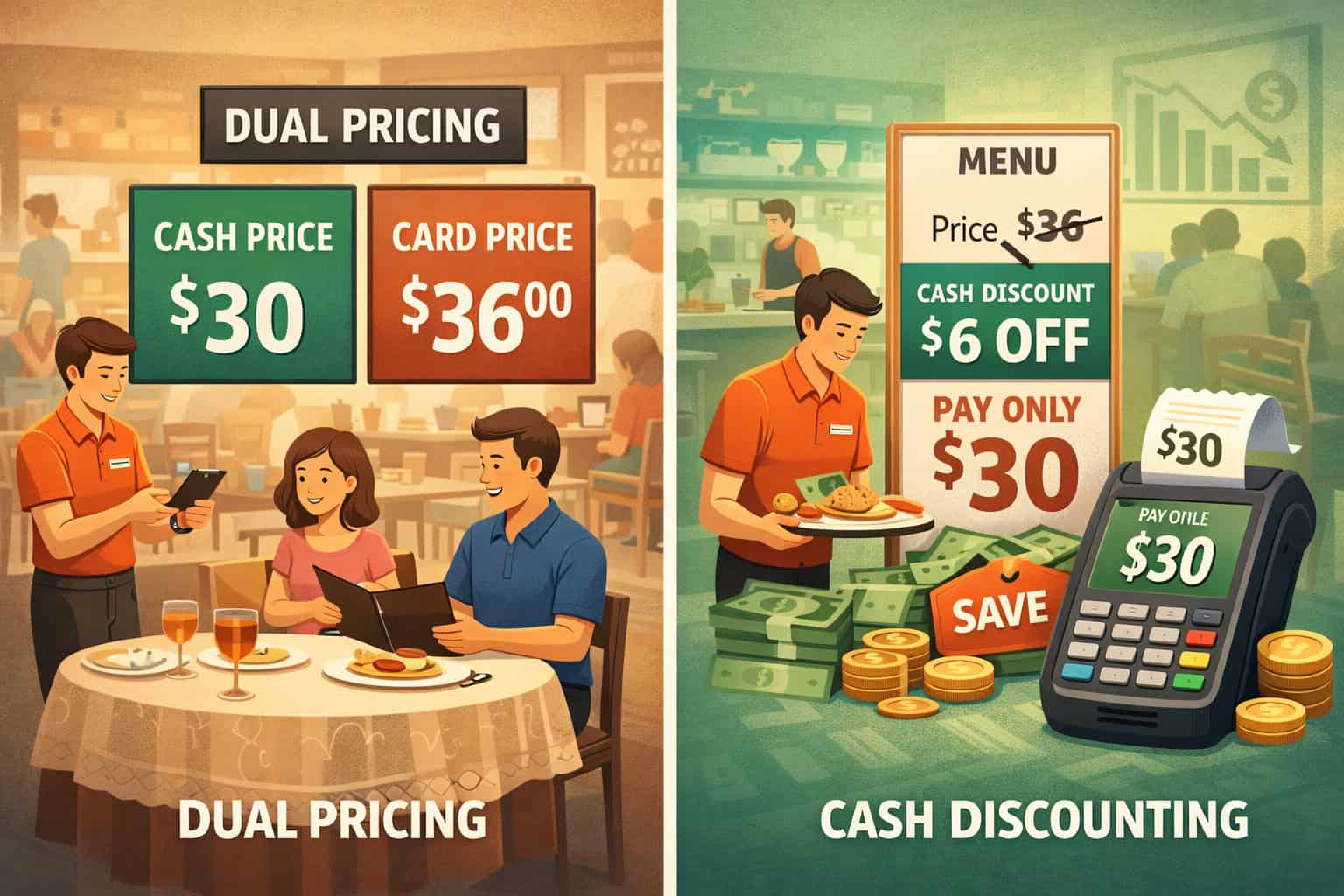
Restaurants are dealing with rising food costs, wage pressure, delivery app commissions, and one expense that quietly grows with every ticket: card acceptance costs. That’s why more operators are exploring dual pricing and cash discounting to protect margins without constantly raising menu prices.
At first glance, dual pricing vs. cash discounting can look like the same idea—customers pay one amount if they use cash and another if they pay by card. In practice, the details matter a lot.
How you display prices, how your POS applies adjustments, how you communicate at the register, and how you follow card-network rules can be the difference between a smooth rollout and chargebacks, complaints, or compliance issues.
This guide breaks down dual pricing vs. cash discounting specifically for restaurant workflows: dine-in, quick service, bar tabs, tips, taxes, online ordering, and delivery. You’ll learn where dual pricing shines, when cash discounting is simpler, what risks to avoid, and how to choose a model that fits your brand, your guests, and your operations.
We’ll also cover what’s changing in payments and why dual pricing may evolve over the next few years as ordering becomes more digital and transparency rules tighten.
What Dual Pricing Means in a Restaurant Setting
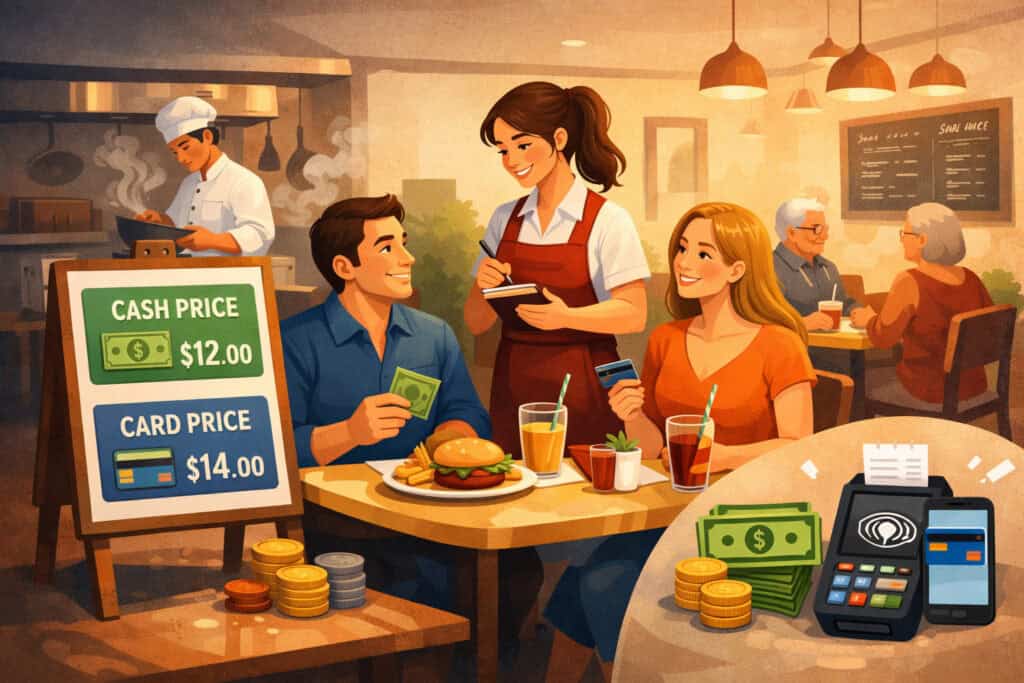
Dual pricing is a pricing strategy where you present two clearly defined prices for the same item or check total—one price for cash (or “non-card”) and another for card payments.
In many restaurant implementations, the “card price” is slightly higher and is designed to help offset processing costs. The key point is that dual pricing is not just a fee added at the end; it’s a structured price presentation that can be applied to menu boards, printed menus, and digital ordering screens.
In a restaurant, dual pricing can be applied at different levels. Some operators dual-price the entire check total, while others dual-price menu items (for example, “Burger: $10.00 cash / $10.40 card”).
Item-level dual pricing is often easier for transparency, but it can be harder to maintain when you change menus or run promotions. Total-level dual pricing can be simpler operationally, but guests may notice the change later in the checkout flow, so communication matters more.
A major benefit of dual pricing is predictability. You can design your card price so it consistently covers a portion of your acceptance costs without needing separate line items that feel like “junk fees.”
At the same time, dual pricing can create brand friction if your concept relies on an “all-in” guest experience. In fast casual or QSR environments, dual pricing can feel normal when displayed clearly. In fine dining, it may feel out of place unless presented carefully and consistently across every channel.
Done well, dual pricing becomes a pricing system, not a surprise. Done poorly, it becomes a checkout argument.
How Dual Pricing Works at the POS and on Receipts
Most restaurant POS systems don’t “magically” understand dual pricing unless you configure it correctly or use a supported pricing feature. Operationally, dual pricing is usually implemented in one of two ways:
- Two price sets stored in the POS (cash price and card price) and selected based on tender type, or
- A non-cash adjustment applied when the guest chooses a card tender, where your displayed “standard” price is the card price and cash gets a discount (this can look like dual pricing to guests, but the mechanics resemble cash discounting).
The first approach is closer to “true” dual pricing because the POS is actually choosing between two price tables. The advantage is clarity: your cash price is your cash price, and your card price is your card price.
The downside is maintenance—every new item, modifier, or combo needs two prices, and you need clean reporting so you don’t confuse menu pricing with discounts.
The second approach can be easier to run because the POS keeps one main price set, then applies an adjustment. But you must be very careful: the way the price is advertised, the language used on signage, and the receipt formatting can determine whether your program looks like a discount (cash discounting) or a fee (surcharge).
Industry legal guidance often emphasizes that properly structured cash discount programs advertise the higher (card) price as the standard and provide a discount for cash at the point of sale.
In restaurants, tips complicate everything. A good dual pricing setup defines whether the price difference applies to pre-tip only (common), or whether it also affects tip calculation (usually avoided to reduce guest confusion). Your receipts should clearly show what the guest paid and why—without making it feel like you punished them for using a card.
What Cash Discounting Means and Why Restaurants Use It
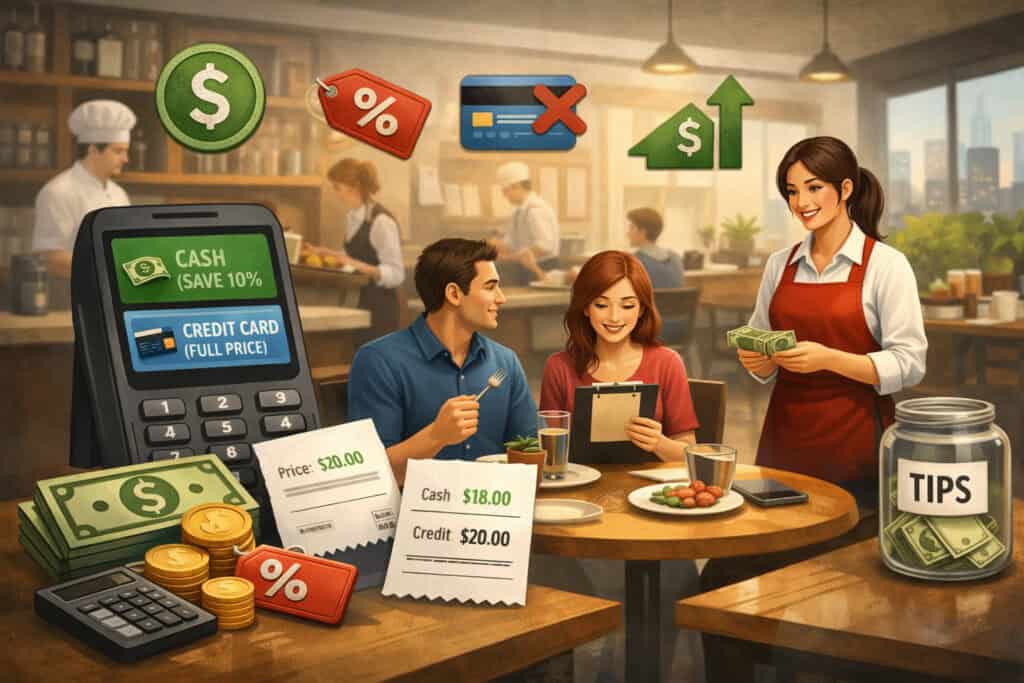
Cash discounting is a strategy where you advertise a standard price and then offer a discount when customers pay with cash or another non-card method.
In day-to-day operations, cash discounting is often implemented as a percentage or flat discount applied at checkout when cash is selected as the tender type. The goal is to encourage cash use and reduce card processing costs by shifting some payments away from cards.
Where dual pricing can look like “two posted prices,” cash discounting usually looks like “one posted price plus a discount for cash.” Many business-focused guides define a cash discount as an incentive for paying with cash rather than card, and they distinguish it from surcharging.
That distinction matters because cash discounting is typically treated more favorably than surcharging in many contexts, but it still requires clear disclosure and correct setup.
For restaurants, cash discounting is popular because it can be simpler than dual pricing to roll out. You may not need to reprint every menu or update every price board.
Instead, you display a short disclosure at entry, at the counter, on the menu, and at checkout: “Prices shown reflect card price; pay with cash and receive a discount,” or a similar statement aligned with your program structure.
Cash discounting can also be easier for promotions. If your “standard” advertised price is the card price, your promos run normally. Then the cash discount happens at payment time. However, guests can still react negatively if they feel misled—especially if the message is only visible at the register.
In other words, cash discounting can reduce friction for your staff and menu management, but it can increase the importance of signage, training, and consistent messaging across dine-in, takeout, online ordering, and delivery.
Cash Discounting at Checkout: The “Standard Price” Problem
The most common operational mistake with cash discounting is advertising the lower cash price as the standard price and then adding something at checkout for card payments. That’s when guests feel “hit with a fee,” even if you call it something else.
Legal and industry guidance frequently stresses that a compliant cash discount model is structured as a discount off a posted price, not a penalty added later.
For restaurants, this becomes tricky because guests see prices in multiple places:
- printed menu
- menu boards
- table tents
- online ordering pages
- third-party delivery listings
- receipts
- payment screens
If one channel shows the cash price and another shows the card price, your staff will spend the night explaining your program instead of focusing on hospitality. That’s why many restaurants that adopt cash discounting standardize on one “card price” everywhere they control and then apply the cash discount at a tender time.
Another common issue is how the discount interacts with tax and tip. Some systems discount the subtotal; others discount the total. If your receipts look inconsistent, guests may assume you’re doing something shady.
Restaurants that succeed with cash discounting usually keep it boring: a consistent approach, consistent language, and consistent receipt formatting—every shift, every terminal, every location.
Dual Pricing vs. Cash Discounting: The Key Differences That Actually Matter
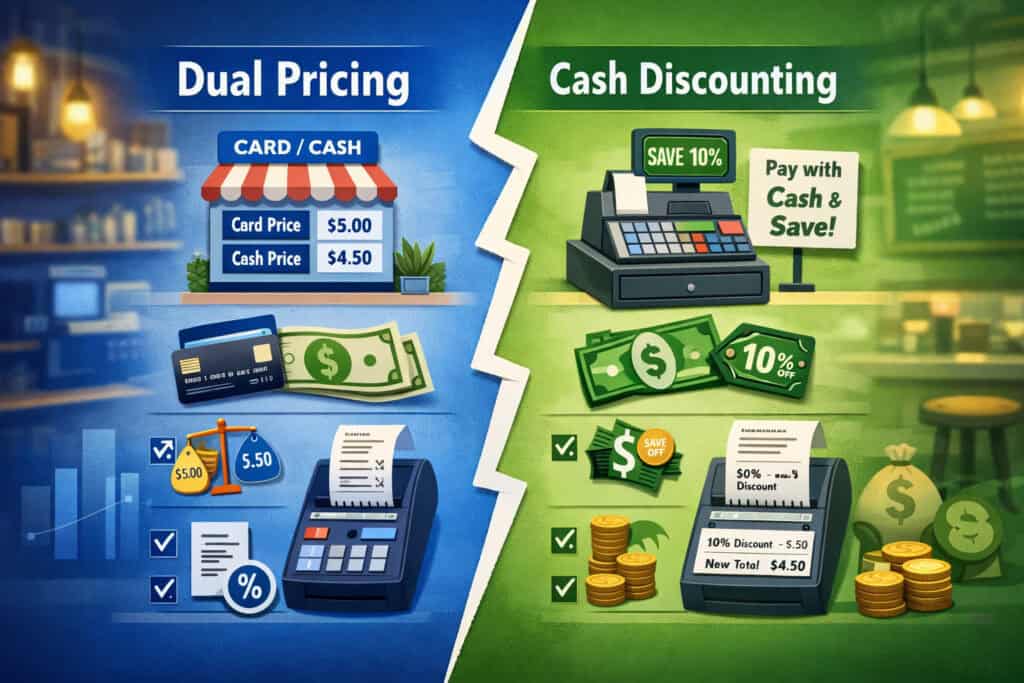
When comparing dual pricing vs cash discounting, the headline difference is how prices are presented. But the practical difference is how guests experience the program and how easy it is for your team to execute it flawlessly.
Dual pricing is often best when you can clearly display two prices where the decision happens—menu boards in a QSR line, a bar menu, or a kiosk checkout.
It tends to reduce “gotcha” moments because the guest can see the card price early. But it requires more menu and POS discipline, and it can get messy when you add modifiers, combos, and happy-hour pricing.
Cash discounting is often best when you want one primary price everywhere and a simple discount when cash is used. It can be easier on menu management, but it increases the burden on disclosures. Guests don’t like surprises, and if they perceive cash discounting as a surprise, they’ll treat it as a fee—even when it isn’t.
There’s also a brand positioning difference. Dual pricing can feel like transparent cost-sharing: “Cards cost more to accept, so card payers pay the card price.” Cash discounting can feel like a reward: “Pay cash and save.”
If your restaurant has a value-driven brand, “save with cash” may land better. If your restaurant is efficiency-driven and already uses kiosks, dual pricing can feel cleaner.
Finally, there’s a reporting and accounting difference. Dual pricing may impact how you analyze item-level sales if you keep separate price sets. Cash discounting often shows up as a discount line, which can be easier to track—but only if your POS categorizes it correctly.
Compliance and Legal Considerations You Can’t Ignore
Pricing programs live in a world of overlapping rules: card network requirements, state rules, consumer disclosure expectations, and your own merchant agreement. You don’t need to become a lawyer, but you do need to understand the difference between cash discounting, dual pricing, and surcharging—because the compliance obligations differ.
Industry legal resources and business associations explain that cash discounts are generally structured as discounts for cash rather than extra charges for card use. Card brand rules and compliance frameworks also matter.
Mastercard, for example, maintains merchant rules and compliance programs that apply across acceptance practices. While the details vary by program type, the consistent theme is disclosure and transparent communication to the cardholder.
If you’re thinking, “I’ll just add a percentage to card tickets,” slow down. That can fall into surcharging behavior, which can be legal in some places and restricted in others. State-by-state restrictions and disclosure rules can change and are frequently summarized in industry compliance overviews, including guides focused on surcharge legality by state.
Because restaurants often serve travelers and process card-not-present transactions (online ordering), it’s smart to assume your policy will be scrutinized. Even if a program is “allowed,” poor disclosure can still trigger disputes and reputational harm.
State-by-State Risk: Why One Location Might Be Fine and Another Might Not
Restaurant groups often expand across state lines, and that’s where things get risky. A pricing practice that looks like a surcharge in one state can attract legal attention or consumer complaints in another.
Even within a single state, enforcement and consumer sensitivity can vary. That’s why many restaurant operators rely on state-by-state summaries when evaluating surcharge-like programs, and why these guides emphasize verifying the current rules before launch.
Here’s the key point for dual pricing: when dual pricing is implemented as clearly disclosed, posted pricing (two prices) or as a properly structured cash discounting model, it tends to avoid the same risk profile as direct surcharging.
But “tends to” is not a compliance plan. You still need to ensure your practice matches the definition of your program, especially in how you advertise prices.
Restaurants are high-visibility businesses. Guests share receipts on social media. Local reporters love “mystery fees.” A single confusing receipt can become a week of reputation cleanup.
So even if you operate in a state where card surcharges are generally allowed, you may decide that dual pricing or cash discounting is a better path because it can feel more transparent.
If you’re multi-location, create one compliance checklist and enforce it everywhere: signage placement, menu language, online checkout language, and receipt line labels. Consistency is what protects you.
Guest Psychology: How Diners React to Dual Pricing vs. Cash Discounting
The success of dual pricing is less about math and more about feelings. Restaurants are hospitality businesses. Even small surprises can feel personal to guests. That’s why the same pricing program can thrive in one concept and fail in another.
Guests usually accept dual pricing when it’s framed as a choice and presented early. If your menu board shows cash price and card price, most guests decide quickly.
If your kiosk shows both options before checkout, it feels like transparency. But if your server drops the check and the guest notices a higher number only after tapping their card, it can feel like a penalty.
Cash discounting can feel friendlier if communicated as “Pay cash, save money.” People like savings. But they only like savings when they trust the pricing. If the guest believes the menu price was the cash price and the card price appears later, the psychology flips: it feels like a fee.
The restaurant environment matters too. At bars, tabs are fast and tips are emotional. If the guest thinks you changed pricing after the fact, you risk lower tips and more disputes. In quick service, speed matters. If staff have to explain the program repeatedly, the line slows down and satisfaction drops.
A reliable approach is “explain once, clearly, up front.” For dual pricing, show both prices wherever people decide. For cash discounting, make it obvious that the posted price is the card price and cash gets a discount.
And for both models, keep the language human. Guests don’t want to hear “non-cash adjustment.” They want “cash price” and “card price,” plus a one-sentence reason.
Menu and Signage Best Practices That Reduce Complaints
Restaurants that succeed with dual pricing treat signage like part of the guest journey, not a legal afterthought. Put the message where it’s useful:
- entrance (so nobody feels trapped)
- host stand or counter (where decisions happen)
- menu board / printed menu (where prices are perceived)
- checkout screen (where payment choice is confirmed)
- receipt (where people verify the total)
For dual pricing, the cleanest signage states that menu prices show both cash and card options. For cash discounting, the cleanest signage states that posted prices reflect card price and cash receives a discount at checkout.
Legal and industry references commonly underline that cash discounts are about offering a discount for cash rather than adding a fee for cards.
Train staff to say it in one sentence without defensiveness. Example: “We have a cash price and a card price because card acceptance costs more—whichever you choose, we’ll take care of you.” The goal is to prevent the guest from feeling judged for using a card.
Also watch your typography. Tiny footnotes look suspicious even when they’re honest. If you’re confident in your program, be confident in your disclosure. Restaurants that communicate clearly usually see fewer arguments—and that alone can be worth more than the savings.
The Financial Side: Estimating Savings Without Fooling Yourself
Restaurants adopt dual pricing or cash discounting to improve margins, but the savings are not automatic. You need to model your situation using your real mix of payments and your real processing costs.
Start with what you’re actually paying today: effective rate (total fees divided by total card volume), monthly fixed fees, chargebacks, and any ancillary fees. Then estimate your expected payment shift.
In many restaurants, you won’t suddenly become a cash-only business. You might move a small percentage of guests to cash, and the rest will keep paying by card. That’s fine—dual pricing can still work because it’s not relying entirely on behavior change. It’s relying on price structure.
With cash discounting, your savings often come from two places: more cash payments and the reduced net cost of card payments if your “standard” pricing supports it. But cash has costs too: counting, depositing, shrink, and time. Some operators overestimate savings by ignoring cash handling and staff time.
With dual pricing, the “savings” can be more predictable because you’re explicitly building acceptance cost recovery into your card price. But you must be careful not to price too aggressively. If your card price difference is too high, you can lose guests or invite reputational backlash.
A smart approach is to set a conservative goal: reduce effective processing burden, not eliminate it. Then monitor weekly: average ticket, tip percentage, complaint rate, and tender mix. If complaints rise, the cost of lost goodwill can exceed processing savings.
Break-Even Thinking: When Dual Pricing Pays Off Faster Than Cash Discounting
A practical way to compare dual pricing vs cash discounting is to ask: “Do I want my savings to come from price structure or from behavior change?”
- Dual pricing leans toward price structure. Even if most guests keep paying by card, the card price helps offset costs. That can create faster, more stable results—especially in concepts where guests rarely carry cash.
- Cash discounting leans toward behavior change. If your guests are price-sensitive and nearby banks/ATMs are convenient, you may see a meaningful cash shift. If not, your discount will apply to a smaller slice of tickets, and savings may take longer.
Restaurants in busy districts, tourist corridors, or high-income neighborhoods often see low cash adoption. In those cases, dual pricing can outperform cash discounting because it doesn’t depend on guests changing habits.
By contrast, restaurants in cash-heavy communities or late-night concepts may see strong results from cash discounting because guests already use cash.
Also consider channel mix. Online ordering is rarely cash. If your business is increasingly digital, cash discounting may shrink as a lever over time. That’s one reason many operators see dual pricing as more future-proof—especially when implemented transparently.
The best programs treat this like a pricing decision, not a processing gimmick. Your guests won’t care what you call it. They’ll care whether it feels fair.
Implementation Checklist for Restaurants
Rolling out dual pricing is a project, not a switch. The operational details determine whether guests accept it and whether your staff can execute it consistently under pressure.
First, decide your structure: item-level dual pricing or total-level dual pricing. Item-level gives transparency but requires menu maintenance. Total-level can be simpler but needs stronger disclosure. Next, align your POS configuration.
Your POS should apply the correct price based on tender type and produce receipts that clearly match what you advertised. Test edge cases: split checks, partial payments, gift cards, refunds, voids, comps, employee meals, and bar tabs.
Then fix your menu and signage. If you’re doing dual pricing, show both prices where guests see prices. If you’re doing cash discounting, make sure the posted prices align with the model and that the discount is clearly described as a discount.
Guidance on cash discount programs repeatedly emphasizes the importance of structuring it as a discount rather than a fee.
Finally, train your team. Give them one script and one escalation path. Managers should know how to handle a complaint quickly—ideally by resolving it once and preventing the same issue all night.
Don’t forget online ordering. If your ordering page shows one price and the pickup counter explains another, you’ll lose trust. Update every channel you control before launch day.
Staff Training for Dual Pricing: The One-Sentence Rule
Your team shouldn’t have to deliver a five-minute lecture about processing costs. The best training for dual pricing is built around consistency and brevity.
Teach staff the one-sentence rule: explain it in one sentence, then move on. For example: “We have a cash price and a card price because card acceptance has added costs—paying cash gets the lower price.” That’s it.
Also train your staff to avoid argumentative language. Guests who complain are usually reacting to surprise, not to math. If your team responds defensively, the guest will double down. If your team responds calmly and consistently, most guests accept it.
Managers should be trained on exceptions. If a guest is truly upset, your manager might choose to comp a small difference to save the experience. The goal of dual pricing is margin protection, but the goal of a restaurant is repeat business. Protect both.
Finally, make sure staff understand what not to do: don’t manually add fees, don’t improvise explanations, and don’t hide signage. A good dual pricing program is visible, boring, and consistent.
Common Pitfalls and How to Avoid Them
The biggest risk with dual pricing is that it can be perceived as a “credit card fee” if you communicate poorly. Even if your structure is legitimate, perception drives reviews and repeat visits.
Pitfall one: inconsistent price displays. If your menu shows one price but the terminal shows another, guests will assume you’re adding fees. Pitfall two: confusing receipt labels. Guests trust receipts more than signs. If the receipt shows “service fee” or “non-cash fee” without context, it will trigger disputes.
Pitfall three: treating dine-in and online differently. If you apply dual pricing at the counter but not online, regulars notice. If you apply it online but your pickup signs don’t explain it, people get angry when they arrive.
Pitfall four: applying adjustments to tips or taxes in a way that confuses guests. Keep the math simple and transparent.
Also watch your marketing. If you advertise “no fees” but run dual pricing without clarity, you invite backlash. Pricing transparency is becoming a larger consumer issue, and restaurants are under more scrutiny than ever.
Finally, don’t ignore compliance. Merchant-focused compliance resources emphasize that “cash discount” is a defined approach, and that surcharge-like behavior is treated differently in many places. The safest path is to pick a model and implement it exactly as intended, with clean disclosure.
Alternatives and Hybrids to Consider
If dual pricing or cash discounting feels too disruptive, there are other approaches that can still reduce your processing burden.
One option is optimizing your processing setup: correct MCC classification, smart routing for debit, and reducing unnecessary fees. Another option is encouraging low-cost tenders without changing pricing: promoting debit, using QR pay-at-table that supports PIN debit, or offering small loyalty incentives that aren’t framed as “card penalties.”
Some restaurants use a hybrid approach: mild dual pricing for counter service and a different approach for full service where guest experience is more sensitive. Others apply dual pricing only to certain channels (like catering orders) where pricing is already negotiated. Just be careful—hybrids can create confusion if regular guests see inconsistent policies.
Convenience fees are another concept, but they typically apply to specific channels or services and come with their own rules, so they’re not a direct replacement for dual pricing in a normal dine-in environment. If you explore that route, ensure your processor and legal counsel confirm channel eligibility and disclosure requirements.
The most important idea is that your pricing strategy should match your concept. If your restaurant brand is built on simplicity and trust, your solution should be invisible or clearly explained—not complicated.
Future Predictions: Where Dual Pricing and Cash Discounting Are Headed
Payments are becoming more digital, more regulated, and more visible to consumers. That means dual pricing and cash discounting will likely evolve in three ways over the next few years.
First, disclosure standards will rise. Consumers, platforms, and regulators are pushing for clearer “price transparency.” Restaurants that implement dual pricing with strong signage and clean receipts will be better positioned than restaurants that rely on last-second explanations. That trend favors dual pricing models that are truly posted and consistent across channels.
Second, cash will keep shrinking in many markets, especially as kiosks, pay-at-table, and online ordering grow. That doesn’t mean cash discounting disappears, but it may become less powerful as a behavior lever in digital-heavy concepts. In those environments, dual pricing can remain effective because it doesn’t rely on a major cash shift.
Third, network and platform enforcement will likely get stricter as complaints rise. Mastercard and other networks maintain compliance frameworks for merchants and ecosystem participants. As more restaurants adopt cost-recovery programs, networks and regulators may pay closer attention to whether programs are accurately described and consistently displayed.
In short: the future rewards transparency. If you use dual pricing, make it obvious and consistent. If you use cash discounting, make the discount real, clearly disclosed, and easy to verify on the receipt.
FAQs
Q.1: Is dual pricing the same as surcharging?
Answer: No, dual pricing is not automatically the same as surcharging, even though guests sometimes confuse them. Surcharging generally means adding an extra fee specifically for using a credit card.
Dual pricing is typically structured as two posted prices—cash price and card price—so the guest chooses between two pricing options rather than being “charged a fee” after the fact.
That said, the line can blur if you implement dual pricing in a way that looks like a surprise add-on. If your menu shows one price and the guest sees an extra percentage only at checkout, it will feel like a surcharge regardless of what you call it. That’s why disclosure and receipt formatting are critical.
Business and legal guidance often distinguishes cash discount programs from surcharge-like fees and emphasizes proper structure and disclosure. If your goal is to avoid surcharge rules and guest backlash, design dual pricing as a posted pricing system or a properly structured discount model—not as a last-minute add-on.
If you’re unsure where your setup lands, get your processor to document the program structure and verify what your POS is doing on the receipt.
Q.2: Will guests stop coming if I implement dual pricing?
Answer: Some guests will complain, but most won’t leave if the program is transparent and consistent. Restaurants lose guests when people feel surprised or misled, not when they see a clear choice. That’s why dual pricing works best when guests see both prices early—on a menu board, kiosk, or menu.
The bigger risk is online reviews. A small number of angry guests can post a photo of a receipt and frame the story as “hidden fees,” even if your signage exists. You prevent that by making signage obvious and by using plain language (“cash price” and “card price”).
Also consider your concept. In value-focused QSR, dual pricing may feel normal. In premium full service, guests may expect a seamless experience and react more strongly. In that case, you might choose a smaller price difference or an alternative strategy.
The most practical approach is to pilot dual pricing for a few weeks, track complaint rate, and adjust messaging. If the program creates constant conflict, it may not match your brand—even if the math looks good.
Q.3: How do tips and taxes work with dual pricing?
Answer: Restaurants should keep tips and taxes simple under dual pricing. Most operators apply the difference to the pre-tip subtotal and leave tip calculation as straightforward as possible. Guests already struggle with tip math; adding complexity increases confusion and suspicion.
Taxes are typically based on the taxable amount of the sale. If you have two posted prices under dual pricing, you should ensure the POS calculates tax correctly based on the actual price charged.
If you use a cash discounting approach (posted card price and a discount for cash), your POS should show the discount clearly so the taxable base is handled correctly according to how the transaction is structured.
The biggest guest-experience problem happens when the receipt doesn’t match what the guest understood from the menu. That’s why the receipt format matters as much as the policy itself.
If your POS can’t produce a clean receipt that supports your dual pricing explanation, fix that before launch. In restaurants, the receipt is the final truth.
Q.4: Can I use dual pricing for online ordering?
Answer: You can, but it’s harder—and it often changes which model makes sense. Online ordering is almost always card-not-present, so cash discounting becomes less relevant unless you accept cash at pickup.
Dual pricing can still work online if your ordering site clearly displays card price and cash price (if cash at pickup is an option) and applies the correct pricing based on the selected payment method.
The operational challenge is channel consistency. Guests might see one price online, another in-store, and a third on third-party delivery apps. That inconsistency creates complaints even if each channel is “technically correct.”
If online ordering is a major revenue stream, many restaurants lean toward dual pricing as a posted pricing system they can control on their owned channels. But third-party platforms may limit what you can display, so you may need a channel-specific plan.
No matter what, keep disclosures visible before checkout. Guests don’t mind choices; they mind surprises.
Q.5: Which is better for a small restaurant: dual pricing or cash discounting?
Answer: It depends on your guest mix, your concept, and how much operational complexity you can handle.
Choose dual pricing if:
- your guests mostly pay by card
- you can display both prices clearly (menu boards, kiosks, printed menus)
- you want predictable cost recovery without relying on behavior change
Choose cash discounting if:
- your neighborhood already uses cash
- you want minimal menu reprinting
- your POS supports a clean, obvious “cash discount” receipt line
In either case, your success will come from clarity. Legal and business resources describing cash discount programs emphasize structure and disclosure as the foundation. And network compliance frameworks exist for a reason: inconsistent or misleading presentation causes disputes.
For many small restaurants, the “best” option is the one your staff can execute perfectly every day.
Conclusion
Dual pricing and cash discounting are both attempts to solve the same restaurant problem: payment acceptance costs that squeeze already-thin margins. The best choice is the one that protects profitability and protects the guest experience.
If your restaurant is card-heavy, digital-forward, or built for speed, dual pricing often wins because it’s predictable and doesn’t depend on guests changing habits. If your restaurant is cash-friendly, community-based, or you want a “reward” framing, cash discounting can feel more positive—if you implement it as a true discount with clear disclosures.
The deciding factor is transparency. Guests can accept almost any pricing model when it’s clear, consistent, and communicated early. They reject models that feel hidden, confusing, or inconsistent across channels.
So don’t treat dual pricing as a trick. Treat it as a pricing system. Build it into menus, POS rules, receipts, and staff training. Do that, and dual pricing can be a sustainable lever—one that helps you keep menu prices stable while still running a healthy restaurant business.