If you want to accept card payments smoothly, understanding merchant account requirements before you apply can save a lot of time, paperwork, and frustration. Many Tennessee business owners assume approval is automatic, only to discover that processors and underwriters want a clear picture of how the business operates, who owns it, what it sells, and how customer payments will be handled.
That matters whether you run a retail shop in Nashville, a restaurant in Knoxville, a home-services company in Murfreesboro, a contractor business in Chattanooga, or an online store shipping across the state. A merchant account is not just a formality. It is a financial relationship that allows your business to process card transactions, deposit funds into your bank account, and manage the risk that comes with accepting payments.
The good news is that most businesses can qualify when they prepare properly. The key is knowing what providers usually ask for, why they ask for it, what can slow approval down, and what you can do before submitting an application. Once you understand the Tennessee merchant account application process, you can approach it with more confidence and fewer surprises.
This guide explains merchant account requirements for Tennessee businesses in practical terms. You will learn what documents are commonly required, how underwriters review applications, how approval standards differ by business type, what mistakes cause delays, and how to improve your odds of getting approved without headaches.
What a merchant account is and why Tennessee businesses need one
A merchant account is a type of business account used to accept card payments. When a customer pays with a credit card or debit card, the money does not usually move directly from the customer’s card to your checking account in one instant. Instead, the transaction passes through the payment network, the card issuer, the processor, and the acquiring side of the payment system. The merchant account acts as part of that setup so your business can receive card funds after transactions are authorized, processed, and settled.
For a Tennessee business owner, this matters because customers expect flexible ways to pay. In-store customers want to tap, dip, or swipe. Service clients may want to pay by invoice link or by card on file. Ecommerce buyers expect a secure checkout page. Restaurants need tip adjustment and quick payment flows. Contractors often need mobile payment acceptance on the job site. Without a proper payment processing setup for local businesses, you can lose sales simply because payment options feel inconvenient.
A merchant account also helps create structure around deposits, refunds, chargebacks, security controls, and reporting. It is different from a personal payment app account or a casual peer-to-peer tool. It is designed for real business activity, with underwriting standards, monitoring, and pricing built around commercial transactions.
In Tennessee, businesses often start exploring payment acceptance soon after they register their business, open a bank account, and get tax-related registrations in place. Tennessee’s business registration and tax registration systems are official starting points for many local companies, and businesses that sell taxable goods or services may need to register with the state depending on what they do. The IRS also makes clear that many businesses need an EIN to manage taxes and business operations.
Why a processor does not just approve every business automatically
A common misconception is that getting approved for card processing is the same as signing up for software. It is not. A payment processor or acquiring provider takes on financial risk when it allows a business to accept cards. If customers dispute charges, if the business closes suddenly, if fraud spikes, or if refund activity becomes excessive, the processor may be left managing losses.
That is why merchant account approval requirements exist. The processor wants to verify that your business is legitimate, financially grounded, properly identified, and operating in a way that matches the application. In practical terms, the provider is asking questions such as:
- Is the business real and properly organized?
- Does it have a valid ownership structure?
- Does it sell legal products or services?
- Are the sales methods clearly disclosed?
- Is the expected processing volume realistic?
- Are refunds, delivery times, and billing practices likely to create disputes?
- Does the business fit a standard-risk or higher-risk profile?
For most Tennessee businesses, these are manageable questions. A boutique, salon, dental practice, landscaping company, or local café will usually move through underwriting more easily if its paperwork is complete and its operations are straightforward. Problems tend to arise when the application is inconsistent, the website is incomplete, sales claims seem unrealistic, or the business falls into a category that attracts more chargebacks or regulatory scrutiny.
Pro Tip: Before you apply, describe your business in one simple sentence that matches your website, invoices, marketing materials, and bank records. Consistency makes underwriting easier.
Merchant account versus payment processor versus gateway
Business owners often use these terms interchangeably, but they are not exactly the same. The merchant account is the financial arrangement that allows the business to accept card funds. The payment processor moves transaction data through the card networks. A payment gateway is the technology that securely transmits online payment information from a website, invoice page, or app.
In the real world, many providers bundle these together, which is why the distinction can feel blurry. Still, it helps to understand the difference because different business models need different pieces. A retail store may focus on a countertop terminal and point-of-sale system. An ecommerce seller may care more about gateway integration, fraud filters, and online checkout performance. A mobile service business may need a virtual terminal, invoice tools, and a handheld reader.
If you are comparing providers, it can help to read related background on setting up your first merchant account in Nashville, how to set up credit card processing for new Nashville businesses, and how to choose the best payment processor in Nashville. These resources are useful for understanding how account approval connects to equipment, software, and the broader payment processing setup for local businesses.
Merchant account requirements for Tennessee businesses explained clearly
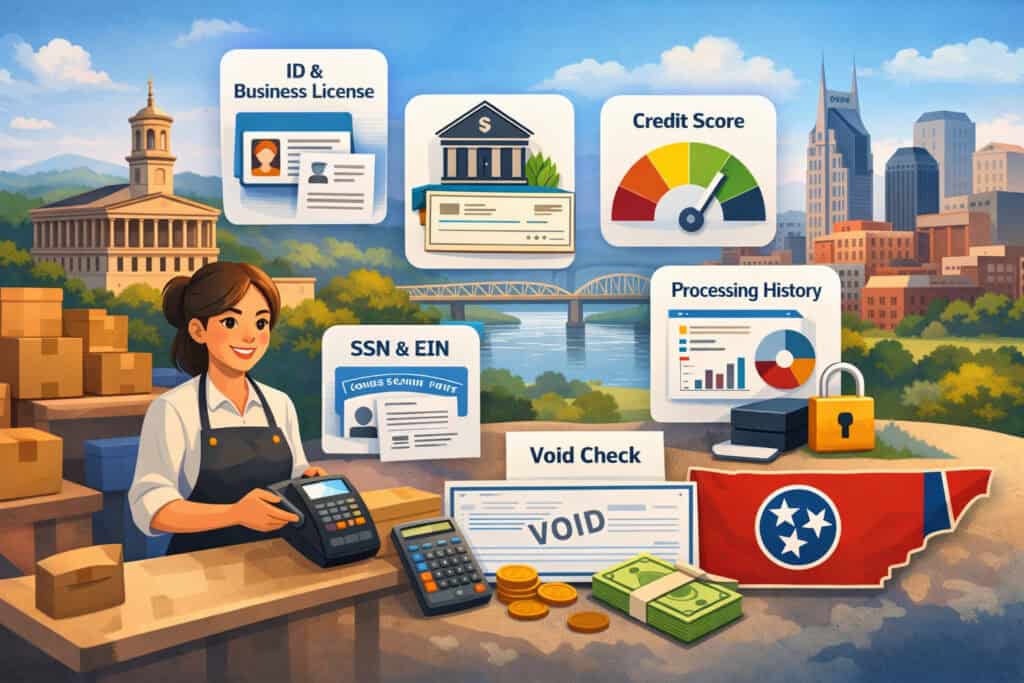
When people search for merchant account requirements Tennessee business owners need to meet, they are usually trying to answer one question: “What do I actually need before I apply?” The answer depends somewhat on your business model, but there are core items that most processors ask for.
At a basic level, underwriters want to verify identity, legal business existence, ownership, banking, and how payments will be accepted. That means your application usually needs to line up across your formation documents, bank records, tax ID details, website, and expected processing activity. The more clearly those pieces fit together, the smoother the process tends to be.
Tennessee business payment processing requirements are not just about having a card reader. They involve your business structure, where your deposits will go, how customers interact with your business, and how disputes or refunds would be handled if something goes wrong.
Legal business formation and business identity
Most providers will want proof that the business exists in a legitimate form. That could mean a sole proprietorship, LLC, corporation, or partnership. The business name on the application should match the legal documents or clearly show the DBA relationship if you operate under a trade name.
Depending on how your business is organized, you may be asked for formation documents, a business license, articles of organization, articles of incorporation, or similar records. Tennessee’s Secretary of State provides business registration pathways for domestic and foreign entities, and many businesses also need tax registration through the Tennessee Department of Revenue based on their activities.
For local merchants, this step is often easy if the business was set up properly from the start. But if you recently changed your business name, switched entities, or operate with multiple DBAs, make sure the documentation is current. An old filing or mismatched name can trigger extra review.
It also helps if your public-facing materials match your legal identity. Your website footer, invoices, social profiles, Google Business listing, and receipts should not confuse an underwriter or future cardholder about who is charging them.
EIN, tax status, and banking information
A processor usually wants your federal tax ID, especially for LLCs, partnerships, and corporations. Sole proprietors may sometimes apply using a Social Security number, but many business owners still prefer an EIN because it keeps the application more business-focused and is often useful for banking and tax purposes. The IRS states that many business entities need an EIN and that legal entities should generally be formed with the state before applying for one.
You will also need a business bank account where processed funds can be deposited. In most cases, the account should be in the business name or otherwise align with the legal entity on the application. Underwriters do not like uncertainty around where settlement funds are going. A bank letter, voided check, or recent business bank statement may be requested to confirm account ownership.
This is one area where startups sometimes stumble. They form the business but continue using a personal bank account, or they have not updated the bank name after a DBA change. That can create delays because the processor needs confidence that funds are being deposited into an appropriate account controlled by the actual business.
Pro Tip: Make sure your legal business name, DBA, EIN records, and bank account setup tell the same story. Clean alignment reduces back-and-forth during underwriting.
Ownership details and responsible parties
Merchant account approval requirements almost always include ownership information. Processors want to know who owns the business, who controls it, and who is responsible for signing the agreement. You may be asked for:
- Full legal names of owners
- Ownership percentages
- Home addresses
- Dates of birth
- Social Security numbers for key owners
- Government-issued ID
- Contact information for the principal signer
This is standard underwriting, not a sign that something is wrong. The provider needs to know who stands behind the business. For closely held companies, this can be simple. For businesses with multiple owners, investors, or layered entities, it can become more detailed.
If ownership is split in a way that is not obvious from the initial documents, be ready to explain it clearly. If one owner handles operations but another owns a large percentage, the application should reflect that. If the signer is not the owner, include authorization documents if needed.
The typical Tennessee merchant account application process

If you want to get a merchant account in Tennessee, the application process usually feels straightforward on the surface: fill out a form, submit documents, and wait for approval. In practice, there are several review stages behind the scenes. Understanding them helps you prepare realistic expectations and avoid surprises.
The Tennessee merchant account application process generally begins with a provider collecting your business information and expected processing profile. That is followed by underwriting, identity checks, possible follow-up questions, approval, account setup, and then technical activation. Depending on the business type, the timeline may be quick or may involve extra review.
Step one: initial application and business profile review
The first step is the formal application. This usually asks for your legal business name, DBA, entity type, tax ID, business address, phone number, bank details, ownership information, website, product or service description, average ticket, monthly processing volume, and card acceptance methods.
This is where accuracy matters most. Do not guess wildly at sales volume, average ticket, or how you plan to use the account. If you are a startup, estimate conservatively and logically. If you are already processing elsewhere, use recent statements to provide realistic numbers.
A retail shop in Franklin may estimate mostly card-present transactions with a moderate average ticket. A contractor in Memphis may show invoice payments, occasional deposits, and some keyed transactions. An ecommerce seller in Tennessee may report all card-not-present volume with shipping delays and online returns. Each of those profiles creates a different underwriting picture.
The processor may also ask whether you accept deposits, offer subscriptions, bill in advance, ship after delayed fulfillment, or sell products in categories that are restricted or higher risk. Be honest. Hiding how your business actually works is one of the fastest ways to create future account problems.
Step two: underwriting and document verification
Once the application is submitted, underwriting begins. This is the review stage where the provider checks the business documents, identity details, bank information, website presence, and risk indicators. For lower-risk local businesses, this can move quickly. For online businesses, contractors, travel-related companies, continuity billing models, or businesses with prior processing issues, the review may take longer.
The underwriter may compare your application against public records, state records, your website, social media, and business bank statements. They may also review whether your business model fits the transaction pattern you described. If you say you sell custom furniture with six-week delivery, but the website has almost no policies and no contact information, the underwriter may pause the file.
This stage is not just about fraud prevention. It is also about forecasting whether the account is likely to generate excessive chargebacks, refunds, or compliance problems. Businesses that communicate clearly and document their operations well tend to look safer.
Step three: approval, conditions, or requests for more information
Not every application receives a simple yes or no. Many receive conditional approval. That means the provider is willing to approve the account if the business supplies more information or accepts certain terms. Common conditions include:
- A request for clearer bank statements
- A copy of a driver’s license
- Website policy updates
- Processing statements from a previous provider
- Supplier or vendor invoices
- Proof of inventory or fulfillment
- Clarification about delivery timelines
- A reserve requirement for higher-risk activity
For Tennessee businesses, this is a normal part of the process, especially if the business is new, online, mobile, or operates in a category that carries elevated dispute risk.
Documents and information underwriters usually ask for

One of the best ways to improve approval odds is to gather documents before you apply. When business owners ask how to qualify for a merchant account, the answer often comes down to preparation. Underwriters are easier to work with when the file is complete, organized, and consistent from day one.
Some providers ask for only a few documents upfront and request more later. Others ask for a full package from the beginning. Either way, these are the most common items involved in requirements for credit card processing Tennessee businesses should expect.
Core document checklist for most businesses
The following table shows a practical checklist of documents and information often requested during underwriting.
| Document or Information | Why It Is Requested | Who Usually Needs It |
| Legal business name and DBA | Confirms who is applying and how the business presents itself | Almost all applicants |
| EIN or tax ID | Confirms tax identity | LLCs, corporations, partnerships, many sole proprietors |
| Business formation documents | Verifies legal existence | New entities and incorporated businesses |
| Business license or local permit | Confirms operating legitimacy where applicable | Many local businesses |
| Business bank statement or voided check | Confirms deposit account ownership | Almost all applicants |
| Owner ID | Confirms identity of principal or signer | Almost all applicants |
| Ownership breakdown | Shows who controls the business | Multi-owner businesses |
| Website URL | Verifies products, pricing, policies, and contact info | Ecommerce and many service businesses |
| Previous processing statements | Helps verify history and volume | Businesses switching providers |
| Supplier invoices or proof of inventory | Shows goods or fulfillment are real | Ecommerce, retail, wholesale |
| Refund and shipping policies | Helps assess dispute risk | Ecommerce, subscriptions, preorder models |
| Financial statements | May support larger or higher-risk accounts | Higher-volume or higher-risk applicants |
This is not an absolute list for every provider, but it is a strong working checklist for merchant account requirements Tennessee businesses commonly face.
Website, service details, and customer-facing policies
If you run an ecommerce business, a service company that takes deposits online, or any business that accepts card-not-present transactions, your website matters more than many owners expect. Underwriters are not looking for a fancy design. They are looking for trust signals and operational clarity.
Your site should usually include:
- A clear business name
- Accurate contact information
- Description of products or services
- Pricing or a clear explanation of how pricing works
- Refund or cancellation policy
- Shipping or delivery policy if applicable
- Terms and conditions when relevant
- Privacy policy
- Visible checkout process for online sales
A blank site, broken links, missing refund language, or vague promises can lead to extra questions. If you bill customers after an estimate, explain that. If you sell custom work that takes several weeks, say so clearly. If you require deposits, show how deposits are handled and whether they are refundable.
This is one reason informational resources like how to enable online payments for Nashville restaurants and the site’s payment gateway articles can be useful. They help business owners understand how online acceptance, policies, and customer communication affect real-world payment processing.
Processing history and supporting financial records
If your business has already accepted cards through another provider, the new processor may ask for recent statements. That helps verify actual volume, average ticket size, refund patterns, chargeback counts, and the types of cards being accepted.
This can work in your favor if your history is stable. A business with strong prior processing history often looks easier to approve than a new business with no track record. On the other hand, if the statements show excessive chargebacks, strange spikes in volume, or high refund activity, expect more review.
Startups without processing history can still qualify, but they may need to support the application in other ways. That could include bank statements, business plans, vendor contracts, signed client agreements, marketing materials, or invoices that show the business is truly operational.
How underwriters evaluate risk and what they care about most
Underwriting can feel mysterious from the outside, but it usually comes down to a simple question: how likely is this account to create losses, disputes, fraud, or compliance issues? Every document, website review, and follow-up question is tied to that core concern.
If you understand how underwriters think, merchant account approval requirements make much more sense. They are not trying to make life difficult. They are trying to predict the future risk of your payment activity based on the information in front of them.
The main risk factors in a merchant account review
Underwriters usually look at several major areas:
- Business type: Some industries historically generate more chargebacks or fraud than others.
- Card-present versus card-not-present volume: Online and keyed transactions generally carry more risk than in-person chip or tap transactions.
- Average ticket size: Larger average tickets increase potential losses per transaction.
- Monthly volume: Higher volume raises the exposure if something goes wrong.
- Delivery timeline: Long fulfillment periods create more opportunity for disputes.
- Refund and cancellation practices: Confusing or strict policies can increase chargebacks.
- Processing history: Prior stable history can help; bad history can hurt.
- Owner background and business transparency: Clear, consistent businesses are easier to underwrite.
A Tennessee restaurant processing mostly in-person transactions with same-day fulfillment often looks very different from an online seller taking preorders for custom items. A plumbing company collecting invoices after completed jobs is different from a coaching business charging recurring subscriptions. The underlying risk profile changes how the application is handled.
Risk levels by business model
Here is a simple comparison showing how different business types are often viewed.
| Business Type | Typical Risk Level | Why |
| Retail store | Lower to moderate | Mostly card-present, immediate fulfillment |
| Restaurant or café | Lower to moderate | In-person payments, quick service, fast fulfillment |
| Local service business | Moderate | Some keyed or invoice payments, occasional deposits |
| Contractor or home improvement | Moderate to higher | Large tickets, progress billing, project disputes |
| Ecommerce store | Moderate to higher | Card-not-present sales, shipping and fraud exposure |
| Subscription business | Higher | Recurring billing and cancellation disputes |
| Travel, events, or future delivery businesses | Higher | Payment collected well before service delivery |
| CBD, firearms-adjacent, adult, or other restricted categories | Higher or specialized | Policy, regulatory, and chargeback considerations |
This table is general, not absolute. A well-run ecommerce business with low chargebacks may be safer than a chaotic local service business with billing complaints. Still, business model is one of the first factors an underwriter considers.
What “high risk” really means in practice
Business owners often hear the phrase high risk and assume it means something bad or suspicious. Not necessarily. In payments, high risk usually refers to how the industry or transaction structure performs from a loss and chargeback standpoint.
A Tennessee contractor may be treated as riskier than a coffee shop because projects involve deposits, delayed completion, and larger invoices. An online supplement seller may face more scrutiny because of card-not-present fraud and product-related disputes. A business that bills monthly memberships may look riskier because customers sometimes forget recurring charges and dispute them.
That does not mean approval is impossible. It means the provider may require stronger documentation, a reserve, tighter monitoring, or different pricing.
Pro Tip: If your business has delayed fulfillment, deposits, recurring billing, or large-ticket transactions, explain your customer communication and refund process clearly in the application. Underwriters want context.
Differences in requirements for retail, ecommerce, service, mobile, and high-risk businesses
Not every Tennessee business faces the same requirements for credit card processing. The core documentation may be similar, but underwriting emphasis changes depending on how you sell, how customers pay, and how long it takes to deliver what was promised.
This is one reason generic advice can fall short. A retail boutique, an electrician, a food truck, and an online seller all need payment processing, but the account review will focus on different things.
Retail stores and restaurants
For retail shops and restaurants, the underwriting emphasis is often on legitimacy, business identity, bank details, and processing expectations. Because sales are usually card-present and fulfillment happens immediately, risk can be easier to evaluate.
These businesses still need clean documentation, but website requirements may be lighter if most transactions happen in person. The processor may care more about:
- Store location
- POS or terminal setup
- Average ticket
- Peak transaction periods
- Tip adjustment needs for restaurants
- Whether the business also sells online
For local merchants, it can also be useful to review practical pieces on credit card processing in Nashville and understanding credit card fees for Nashville merchants, especially if you want to connect account approval with everyday operating costs.
Ecommerce sellers
Ecommerce businesses face more detailed scrutiny because all transactions are card-not-present. Fraud exposure, shipping delays, refund disputes, and customer confusion all matter more.
Underwriters often pay special attention to:
- Website completeness
- Product descriptions
- Shipping timelines
- Return policy
- Customer service contact methods
- Descriptor clarity
- Supplier relationships
- Previous chargeback history
If the site is unfinished, missing policies, or unclear about when buyers receive goods, approval may stall. Dropshipping models, preorders, digital goods, and high-ticket online sales often receive even closer review. The processor wants to know that customers will recognize the charge, receive what they ordered, and know how to contact the business before filing a dispute.
Service-based, mobile, and contractor businesses
Service businesses and mobile merchants often fall into a middle category. A salon, HVAC company, consultant, handyman, or wedding vendor may process a mix of deposits, invoices, stored cards, and in-person transactions. That variability is what underwriters focus on.
They may want to understand:
- Whether you bill before or after service
- Whether deposits are refundable
- Whether customers sign service agreements
- How far out appointments are booked
- Whether you process on-site using a mobile device
- Whether invoices are paid online or by phone
Contractors and home improvement companies may receive more scrutiny than other service businesses because tickets are larger and projects can extend over time. Underwriters may want copies of contracts, invoice examples, and more clarity about refund policies or milestone billing.
Mobile sellers, including event vendors and market merchants, may also need reliable equipment and a stable processing explanation. For example, mobile POS systems for Nashville farmers markets and events is a helpful reference for businesses that need portable acceptance and practical operational planning.
Common reasons applications are delayed or denied
Many businesses that ask how to get a merchant account in Tennessee are perfectly eligible but still run into delays. Often, the problem is not the business itself. It is incomplete information, inconsistent details, or a risk profile that was not explained well.
A delay does not always mean a denial is coming. But it does usually mean underwriting still has unanswered questions.
The most common delay triggers
Applications are often delayed for reasons like these:
- Legal name does not match the bank account
- Missing or invalid EIN information
- Ownership percentages are unclear
- Website is incomplete or not live
- No refund, return, or shipping policy
- Application volume seems unrealistic
- Business category is described too vaguely
- Requested documents were submitted partially
- Prior processing statements show problems
- Address or phone records do not line up
Something as simple as using the DBA in one place and the legal entity name in another can create unnecessary confusion. A business that says it is a retail store but has only an online checkout site may invite extra questions. A company that claims low-risk same-day service but actually collects large nonrefundable deposits months in advance may look misrepresented.
Common denial reasons
Actual denials usually happen when risk is too high for the provider’s model, or when the underwriter cannot get comfortable with the legitimacy or stability of the business. Examples include:
- Prohibited or restricted industry
- Excessive previous chargebacks or fraud
- Inability to verify ownership or identity
- Negative processing history
- Poor banking history in some cases
- Misrepresentation in the application
- No clear evidence the business is operational
- High-risk billing structure without adequate support
Sometimes a business is denied by one provider but approved by another that serves that category better. That is why a denial should not always be viewed as the end of the road. It may simply mean the first provider was not the right fit.
Pro Tip: If you are unsure how your business category is viewed, ask the provider early whether your model is considered standard risk or requires special underwriting. That can save days of back-and-forth.
How Tennessee businesses can improve approval odds before applying
The best way to qualify for a merchant account is to look at your business the way an underwriter would and fix weak points before the application is submitted. A little preparation can move you from “needs review” to “easy approval” much faster.
This does not mean making your business look perfect. It means making it easy to understand and easy to verify.
Build a clean, complete application file
Before you apply, gather your core documents into one organized folder. Double-check names, addresses, tax ID details, and ownership information. Make sure the signer has authority to submit the application.
Then review your business presence from an outsider’s perspective. Does your website clearly explain what you sell? Can a customer find your phone number? Are your refund and shipping policies visible? If you are a local service business, can someone tell what area you serve and how billing works?
If you have existing processing history, have a few recent statements ready. If you are a startup, have supporting materials such as invoices, contracts, permits, or vendor information that prove the business is real and active.
Keep volume estimates realistic
Many new businesses think it looks better to project big numbers. In reality, unreasonable volume estimates can create more scrutiny. If you tell the provider you expect to process a very high monthly volume immediately, but your website is new and your bank history is limited, the file may look inconsistent.
A practical estimate is much better. If you are opening a local boutique, estimate based on foot traffic, average ticket, and expected launch pace. If you run a home services company, estimate based on your booked jobs and expected deposit structure. Realistic expectations build trust.
Make your policies customer-friendly and visible
Chargebacks often happen because customers are confused, cannot reach the business, or did not realize the billing terms. That means visible policies help underwriting and operations at the same time.
Your site, invoices, or signed agreements should make clear:
- What the customer is buying
- When the product or service will be delivered
- What the refund or cancellation terms are
- How billing descriptors may appear
- How to contact customer support
This is especially important for ecommerce, custom work, recurring billing, and deposit-based businesses. A processor wants to see that you are set up to prevent avoidable disputes.
What to expect after approval
Getting approved is a major step, but it is not the end of the process. Once the account is approved, your business still has to be activated, configured, and monitored properly. This is where many business owners shift from underwriting questions to operational questions.
Approval generally means the provider is willing to board your account under certain terms. It does not automatically mean every feature is turned on or that you can start processing without setup.
Account setup, equipment, and software configuration
After approval, your provider may help configure one or more of the following:
- Terminal or countertop device
- POS system
- Payment gateway
- Virtual terminal
- Mobile card reader
- Invoice or recurring billing tools
- Ecommerce integration
- User permissions and reporting access
This is the practical side of payment processing setup for local businesses. A retail store may need inventory-linked POS configuration. A restaurant may need tipping workflows. A service company may want invoice links and customer card storage. An online seller may need gateway integration and fraud controls.
You should also expect to complete or confirm PCI-related steps, device setup, and user training. Some providers will guide you through this, while others leave more of it to the business.
Monitoring, reserves, and funding expectations
Even after approval, processors continue monitoring accounts. That is normal. They track chargebacks, refunds, suspicious transactions, sudden volume spikes, and other signs that risk may be rising.
Some businesses also receive rolling reserves or other conditions, especially if they are considered higher risk. A reserve means a portion of processed funds may be held temporarily as a safeguard against future disputes or losses. Not every business has one, but it is not unusual in certain categories.
Funding times also vary. Some businesses receive deposits quickly, while others may see longer settlement timing depending on processing method, weekends, holidays, or account conditions. Ask for clarity upfront so cash flow planning is realistic.
Fees, contracts, and setup details worth reviewing carefully
Many Tennessee business owners focus so heavily on approval that they do not look closely enough at pricing and contract terms. That can lead to frustration later. Getting approved matters, but getting approved into the wrong fee structure or agreement is not a win.
When comparing providers, look beyond the headline rate. The true cost of processing can include monthly fees, gateway fees, PCI-related fees, chargeback fees, statement fees, equipment charges, and early termination terms.
Questions to ask before signing
Review these details carefully:
- What pricing model is being offered?
- Are rates different for card-present and card-not-present transactions?
- Are there monthly minimums?
- Is there a contract term?
- Is there an early cancellation fee?
- Are PCI fees separate?
- Are gateway fees billed separately?
- Are equipment leases involved?
- How are chargeback fees handled?
- Is support available when your business is busiest?
Educational resources like understanding interchange fees, how to reduce credit card processing costs in Nashville, and how to avoid hidden credit card fees in Nashville can help you understand what to look for when comparing offers.
Why contract transparency matters as much as approval
A low quote can look attractive until extra fees appear later. One provider may advertise a tempting rate but attach long contract obligations. Another may offer a slightly higher rate with clearer billing and better flexibility.
For small businesses, clear pricing often matters more than flashy promises. You want to understand your effective cost, not just the sales pitch. That is especially important for restaurants, retailers, and service businesses operating on tight margins.
Pro Tip: Ask every provider to explain all recurring, transactional, and one-time fees in writing before you sign anything. A clean fee summary makes side-by-side comparison much easier.
Common mistakes businesses make during the merchant account application process
Most application problems are avoidable. Business owners are usually busy, moving fast, and trying to get payment acceptance live. In that rush, they make simple mistakes that create bigger issues than necessary.
The strongest applications are not always the ones with the largest revenue or longest history. They are often the ones that are complete, consistent, and easy to verify.
Mistake one: applying before the business basics are ready
Some businesses apply before they have finished business formation, opened a business bank account, built a working website, or clarified ownership. That can be especially common with startups that want payments ready immediately.
While it is smart to prepare early, it is usually better to apply once your fundamentals are in place. That means your legal entity, bank account, tax ID, customer-facing materials, and billing model should already make sense.
Mistake two: describing the business too vaguely
An application that says “consulting,” “sales,” or “services” without more detail does not help underwriting. The provider wants to know what you actually do, how you get customers, how you bill them, and when delivery happens.
A better description might be “residential HVAC repair and replacement with deposits and final invoice billing” or “online store selling handmade candles shipped within five business days.” Specificity lowers uncertainty.
Mistake three: ignoring the customer experience side
Some owners think underwriting is all about paperwork. But customer communication matters too. Missing policies, no visible phone number, unclear descriptors, hard-to-find cancellation terms, and poor refund communication all increase the chance of disputes.
Underwriters know this. That is why a polished customer-facing setup can help the application just as much as a clean bank statement.
Tips for choosing the right payment processor or merchant services provider
Once you understand the requirements for credit card processing Tennessee businesses usually face, the next step is choosing the right provider. Approval is important, but fit is just as important. The right provider should match your business model, transaction style, and support needs.
A restaurant has different priorities than an online store. A contractor needs different tools than a boutique retailer. That is why a processor should be evaluated based on your actual operations, not just pricing slogans.
Match the provider to your business model
Start by asking whether the provider works well with businesses like yours. If you are primarily in person, you may care most about terminal reliability, POS compatibility, and funding clarity. If you are online, you may care more about gateway quality, fraud tools, and checkout integration. If you are mobile, portability and connectivity matter.
Also consider whether the provider understands local business realities. Tennessee businesses often operate across in-person, mobile, and online channels at the same time. A flexible provider should be able to support that mix without making the setup feel fragmented.
Look for support, transparency, and practical guidance
The best providers are not always the cheapest at first glance. They are the ones that make it easier to run your business well. That includes straightforward underwriting, clear billing, realistic onboarding help, and responsive support when something breaks or a chargeback appears.
Use a practical checklist:
- Does the provider support your type of business?
- Is pricing explained clearly?
- Are contract terms easy to understand?
- Will the hardware or software fit your workflow?
- Is support available when you need it?
- Are there tools for invoicing, online payments, or recurring billing if needed?
- Will the provider help with setup and compliance basics?
If you are still comparing options, payment processing trends Nashville merchants should watch can also provide useful context on broader acceptance features and operational changes affecting Tennessee businesses.
FAQs
Do I need a business license to get a merchant account in Tennessee?
In many cases, yes, or at least some form of documentation showing your business is properly organized and allowed to operate. The exact requirement depends on your business type, location, and industry. Some providers ask for a business license directly, while others may accept formation documents, tax registration records, or local permits depending on how your business is structured.
Can a new business with no processing history still get approved?
Yes. A startup can often qualify for a merchant account if the application is complete and the business is easy to verify. In these cases, underwriters may look more closely at formation documents, bank account details, owner identification, website quality, invoices, contracts, and other proof that the business is active and legitimate.
Do I need an EIN, or can I apply as a sole proprietor?
Some sole proprietors may be able to apply without an EIN, but many business owners still choose to get one for a cleaner business setup. For LLCs, corporations, partnerships, and many other entity types, an EIN is commonly expected during the merchant account application process. It helps confirm the tax identity of the business and supports banking and underwriting verification.
Why does my website matter if I mostly work locally?
Your website often acts as part of your business verification during underwriting. Even if most of your sales come from walk-ins, referrals, or local appointments, processors use your website to understand what you sell, how customers contact you, and whether your policies are visible. A simple but complete site is often much more helpful than a stylish site with missing information.
What is the biggest reason merchant account applications get delayed?
The most common reason is inconsistency. This can include mismatched business names, incomplete ownership details, unclear bank information, a weak or unfinished website, or processing estimates that do not match the business model. Delays usually happen because the underwriter still needs a clearer picture of how the business operates.
Are ecommerce businesses harder to approve than retail stores?
Often, yes. Ecommerce businesses usually process card-not-present transactions, which carry higher fraud and chargeback risk than in-person payments. Because of that, underwriters tend to review websites, product descriptions, shipping timelines, refund policies, and customer service details more closely before approving an online business.
Will a previous chargeback problem prevent approval?
Not always, but it can lead to more review. A processor may ask for recent statements, an explanation of the issue, and proof that the problem has been corrected. If the chargeback issue was limited and your business has taken steps to improve billing, customer communication, or refund handling, approval may still be possible.
How long does it take to get a merchant account in Tennessee?
The timeline depends on the business type, the provider, and how prepared your documents are. A straightforward local business with complete paperwork may be approved fairly quickly, while ecommerce, contractor, mobile, or higher-risk businesses may take longer if underwriting requests additional documentation or clarification.
What should I review most carefully after approval?
Pay close attention to pricing, contract length, monthly fees, chargeback fees, PCI-related costs, equipment terms, and funding timelines. Many business owners focus so much on approval that they overlook the agreement details. Reviewing the full fee structure and service terms carefully can help prevent unpleasant surprises later.
Conclusion
Understanding merchant account requirements for Tennessee businesses is one of the smartest things you can do before accepting card payments. It helps you avoid delays, submit a stronger application, and choose a payment setup that actually fits how your business operates.
The process becomes much easier when you treat it as more than a form. Underwriters want to see a legitimate, organized business with clear ownership, accurate banking, realistic volume expectations, and customer-facing policies that reduce confusion and disputes. Whether you run a retail shop, restaurant, service company, contractor business, mobile operation, or ecommerce store, preparation makes a major difference.
If you want to get a merchant account in Tennessee with fewer obstacles, start by organizing your documents, tightening up your website or customer paperwork, matching your legal and banking details, and describing your business honestly and clearly. Once those foundations are in place, the Tennessee merchant account application process is far more manageable.
A merchant account is not just a way to process cards. It is part of the infrastructure that supports your cash flow, customer experience, and long-term growth. When you understand the requirements upfront, you put your business in a much better position to get approved smoothly and start accepting payments with confidence.