
Nashville has grown into a year-round destination where live music, conventions, sports, and a steady calendar of events keep occupancy high and turnover fast. That pace changes what “good payments” look like for property managers, vacation rental operators, boutique hotels, and experience providers.
When you’re juggling direct bookings, OTA reservations, owner statements, vendor bills, maintenance dispatches, taxes, deposits, and refunds—payments can’t live in a silo. They need to be built into the systems your team already uses, so money movement is predictable, trackable, and easy to reconcile.
That’s exactly what integrated payments deliver: card and bank payments embedded into property management and hospitality workflows so every transaction automatically connects to a guest folio, reservation, work order, owner ledger, and accounting category.
Instead of exporting spreadsheets, matching deposits line-by-line, and hunting down “mystery payouts,” integrated payments keep booking revenue, fees, taxes, and payouts aligned from the moment a guest clicks “Reserve” to the moment the owner receives their distribution.
This matters even more in a market where visitor spending continues to set records and travel volume remains strong. Davidson County visitor spending reached $11.2 billion in 2024, reinforcing how large the opportunity is—and how costly payment friction can become when you’re operating at scale.
In this guide, you’ll learn how integrated payments fit the Nashville property management and tourism ecosystem, how to choose the right rails for guest and owner expectations, how to reduce fraud and chargebacks, and how to build a payment stack that stays compliant and future-ready.
Why Nashville’s property and tourism economy demands integrated payments
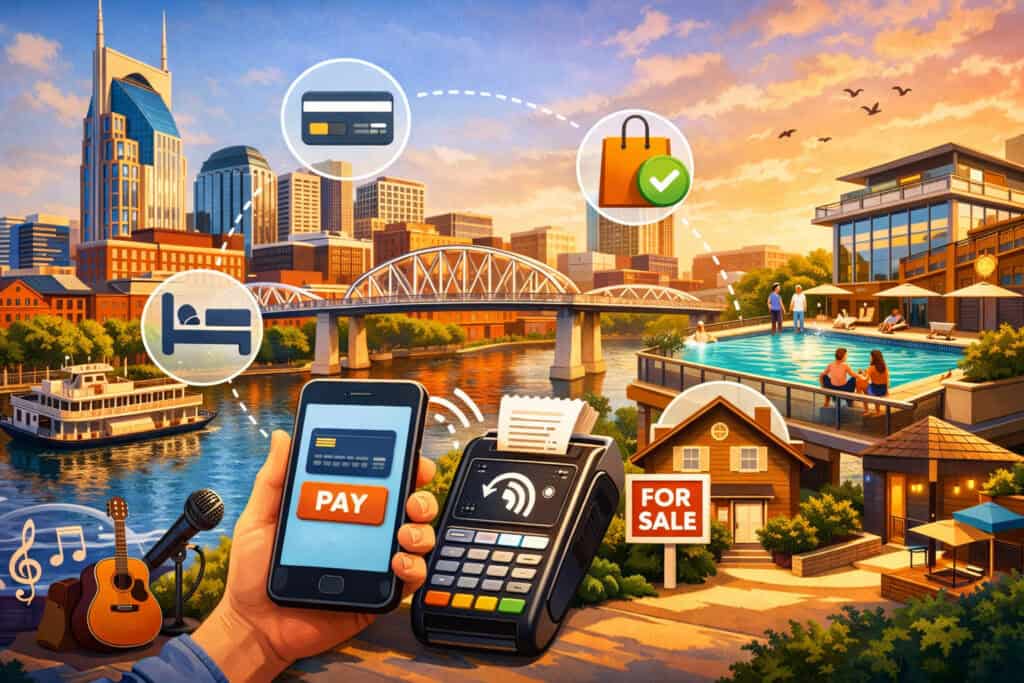
Nashville’s tourism engine is not just busy—it’s operationally intense. High occupancy weekends, event surges, and fast turnovers create a cashflow environment where timing and accuracy matter as much as volume.
That’s why integrated payments have become a competitive advantage for local property managers and tourism operators: they reduce manual work, compress time-to-cash, and create clean financial records that scale with demand.
In a growing destination, the number of payment “touchpoints” multiplies quickly. Guests may pay through a booking site, pay a deposit directly, split a bill, extend a stay, or request a partial refund due to schedule changes.
Owners expect consistent distributions, transparent fees, and statements that match what they see in the portal. Vendors want quick settlement so they can prioritize your work orders during peak season.
Every one of those moments becomes easier when integrated payments link transactions directly to reservations, properties, and ledgers.
Nashville’s recent visitor-spend numbers also mean competition is intense: every friction point—failed cards, slow refunds, confusing payment links, or unclear receipts—can turn into a bad review. Meanwhile, the more you grow, the more reconciliation can choke your team.
A single busy month can create hundreds or thousands of line items that must be tied back to the right booking and property. Integrated payments reduce that risk by ensuring each transaction carries the right metadata from the start.
Finally, local compliance pressures (especially for short-term rentals) increase the need for clean records. When permits, taxes, and reporting requirements are in play, you want payment history and booking history to line up without manual patchwork.
Integrated payments help you prove what was collected, when it was collected, and how it was distributed—without building a paperwork mountain.
Key revenue streams and payment moments across the guest journey
In Nashville hospitality and property management, revenue doesn’t come from one single “room rate.” It comes from a stack of charges that need to be collected, tracked, and distributed correctly—often across multiple parties. Integrated payments are most powerful when they support the full guest journey and the full owner lifecycle.
Common guest payment moments include: booking deposits, balance collection before arrival, security deposits or damage waivers, add-ons (parking, early check-in, late checkout), cleaning fees, pet fees, and experience bundles such as tickets or guided tours.
In tourism-heavy neighborhoods, stays may be short and turnovers frequent, which increases refund frequency and dispute risk. Integrated payments help by keeping each charge tied to a folio and a policy—so refunds are quick, consistent, and documented.
On the owner side, payment complexity shows up in management fees, channel commissions, occupancy taxes, maintenance deductions, and reserve funds.
Owners don’t just want a payout—they want confidence that the payout is right. Integrated payments make it easier to automate owner distributions, show fee breakdowns, and keep a clear audit trail.
For local teams, the operational “payment moments” include paying cleaners and contractors, collecting reimbursements, processing incidental charges, and handling chargebacks.
Integrated payments create a single source of truth so your staff doesn’t have to stitch together the story across emails, bank portals, and spreadsheets. In a city where tourism economics remain strong, the operators who master these workflows tend to scale faster and protect margins better.
What “integrated payments” means in property management and hospitality
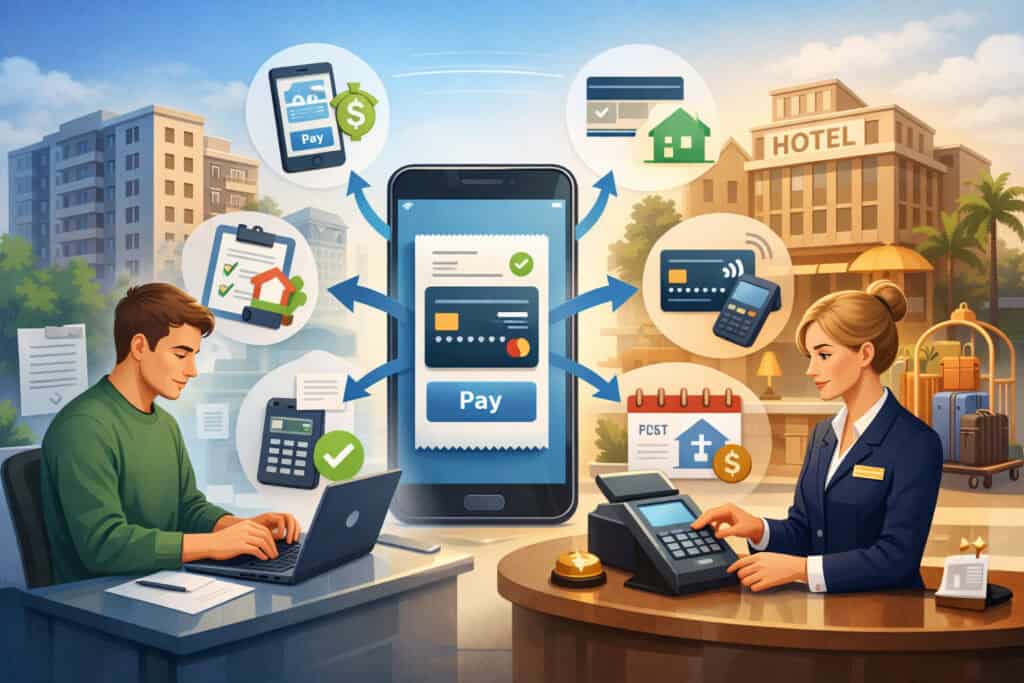
Integrated payments are not just “taking cards.” They’re a design approach where payments are embedded inside the software that runs your operations—property management systems (PMS), booking engines, channel managers, CRMs, and accounting platforms—so transactions are automatically created, labeled, routed, and reconciled.
Instead of treating payments as an external step, integrated payments make payments a native part of reservations, ledgers, and reporting.
For Nashville property management, integrated payments typically mean your staff can send secure payment links, store customer payment credentials safely (using tokenization), schedule auto-collection based on policy (like “50% at booking, 50% 14 days before arrival”), and automatically post charges to the correct folio.
For tourism operators—like tour companies, shuttle providers, and entertainment venues—integrated payments can unify online checkout, in-person payments, gratuities, and refunds in one reporting view.
The biggest operational win is reconciliation. When integrated payments are properly set up, your deposits are not mystery lumps. They arrive already mapped to bookings, properties, and fee categories—so month-end close becomes a workflow, not a detective mission.
That translates into fewer accounting errors, faster owner statements, and better decision-making because your numbers are clean.
Integrated payments also support smarter risk controls. Instead of waiting for chargebacks or fraud spikes, you can enforce consistent authorization rules, apply stronger customer authentication for risky transactions, and use real-time signals to flag anomalies.
Payment operations become proactive instead of reactive, which is crucial when peak tourism seasons bring both higher revenue and higher fraud exposure.
The tech stack: PMS, CRM, channel manager, accounting, and embedded payments
Most successful Nashville operators don’t run on one system—they run on a stack. Integrated payments work best when your stack shares consistent data and naming rules so transactions stay traceable.
The typical architecture includes: a PMS (or property management platform), a direct booking engine, channel distribution (OTAs), a CRM or guest messaging layer, accounting software, and a payments layer that ties everything together.
In practice, integrated payments should do a few critical jobs across that stack. First, it should create a single customer payment identity (token) that can be used for authorized charges without storing raw card data in your system.
Second, it should attach payment metadata—booking ID, property ID, guest name, channel, stay dates—so reconciliation is automatic. Third, it should manage multiple payment flows: guest collections, owner payouts, vendor payments, and platform fees (if you’re a management company with layered entities).
Nashville operators also benefit from embedded payout logic. For example: owner payouts can be scheduled weekly, cleaning payouts triggered after checkout, and reserve funds automatically retained.
When this is driven by integrated payments, you reduce delays and disputes because every participant sees consistent reporting.
Finally, the best integrated payments setups support flexible “rails”: cards, ACH, instant payments, and digital wallets. That flexibility matters because traveler preferences vary by age group, booking channel, and trip type—bachelorette weekends, conventions, family trips, and corporate stays all behave differently at checkout.
Compliance, permits, and tax realities in Nashville rentals

Property management and tourism in Nashville sit close to regulation—especially for short-term rentals. This affects how you collect money, how you document transactions, and how you report.
Integrated payments can’t replace compliance work, but they can make compliance dramatically easier by creating consistent records, minimizing manual edits, and preserving an audit trail.
For short-term rentals, Nashville and Davidson County require permits for operating on short-term rental platforms before listing, and rules can vary by permit type and property status. Operators should rely on official municipal guidance and keep documentation current.
The practical payment takeaway is simple: when your booking and payment records are aligned, it’s easier to show what happened and when it happened—especially if questions arise about occupancy periods, collected fees, or guest identity.
Tax handling is another major issue. Depending on your business model, you may need to collect and remit occupancy-related taxes, track taxable vs non-taxable fees, and handle marketplace facilitator rules where certain platforms collect some taxes on your behalf.
This can become confusing fast when you take direct bookings plus OTA bookings. Integrated payments help by assigning the right tax codes and fee categories per booking source, then reporting totals consistently.
Security and privacy also fall under “compliance reality.” If your team is passing around card numbers, saving screenshots, or collecting payments through insecure links, you expose the business to avoidable risk.
Integrated payments reduce that exposure because secure checkout, tokenization, and controlled permissions become the default workflow.
Short-term rental permits, local rules, and how payments help prove compliance
Nashville’s short-term rental permitting process is a real operational constraint, not a formality. Since permits are required prior to listing, operators need dependable systems for recordkeeping and for proving their booking activity aligns with policy.
Even if your team is fully compliant, messy records can make you look careless during reviews, partner onboarding, or insurance claims.
Integrated payments support compliance proof in several practical ways. First, they create a consistent timestamped record of charges and refunds—useful for showing reservation timelines and occupancy-related collections.
Second, they keep guest identity and booking details linked to the transaction, which helps your team respond to disputes, neighborhood complaints, and operational incidents. Third, integrated payments can help ensure required fees (like cleaning or damage coverage) are applied consistently rather than “sometimes forgotten.”
For multi-property operators, the biggest compliance risk is often inconsistency: one team member collects taxes differently, another uses a different descriptor on receipts, and a third refunds without documenting the reason.
Integrated payments allow you to standardize policies across properties—so fee rules, refund policies, and authorization procedures are the same every time.
A final compliance edge: cleaner financial reporting helps you work with banking partners, insurance providers, and professional advisors. When your financial story is clear, it’s easier to grow.
And in a destination market where spending remains strong and more operators compete for visibility, that operational maturity is part of the brand you’re building.
Choosing payment methods that match traveler expectations

In Nashville tourism, checkout expectations are shaped by convenience culture. Guests want fast booking confirmation, transparent fees, and modern payment options. Owners and vendors want reliable payout timing. Integrated payments let you offer a range of payment methods while keeping the back-office unified.
Card payments remain the default for travel, but digital wallets (like tap-to-pay and wallet checkouts) increasingly influence conversion. Bank payments like ACH can be ideal for longer stays, corporate housing, and larger ticket amounts where fees matter.
And instant payment rails are gaining attention because they can speed up disbursements and reduce reliance on checks.
The “right” mix depends on your booking profile. If you rely heavily on weekend leisure travelers, you’ll prioritize frictionless card acceptance, mobile-optimized checkout, and fast refunds.
If you manage mid-term rentals or furnished corporate housing, you may prioritize ACH, invoicing, scheduled collections, and flexible payment terms. Integrated payments support these differences without forcing you into separate systems.
It’s also important to think about failure modes. Travel-related cards fail for common reasons—bank declines, address mismatches, authentication challenges, and limit issues. Integrated payments help you reduce failures by using account updater services, smart retries, and policy-based collection schedules (for example, collecting earlier for high-risk bookings).
When payments are integrated, your guest messaging and payment events can trigger each other automatically, lowering both cancellations and manual follow-ups.
Cards, digital wallets, ACH, and instant payments
Card acceptance is still the anchor for hospitality, but the winning approach in Nashville is to make it smarter, not just available.
Integrated payments let you store payment credentials securely (tokenized), perform authorizations for deposits, and charge in stages based on your policy. This reduces last-minute scrambles and improves cash predictability during busy event weekends.
Digital wallets matter because they reduce typing friction on mobile. Guests booking from a phone—often while coordinating group trips—are more likely to convert when checkout is quick.
Integrated payments support wallet buttons and modern authentication flows, which can also reduce fraud in certain scenarios. ACH is valuable when fees are a concern or when you’re dealing with longer stays and larger amounts.
For example: corporate bookings, insurance stays, relocation housing, and some owner payments can be a strong fit for ACH. The key is making ACH feel as seamless as cards, with clear confirmation, automated reminders, and easy reconciliation—again, a core benefit of integrated payments.
Instant payments are the emerging edge. The RTP network operated by The Clearing House reported major growth and high transaction values, signaling broader adoption and use cases beyond person-to-person transfers.
Meanwhile, the Federal Reserve’s FedNow continues expanding participation and use cases, which reinforces the trajectory toward faster settlement expectations. For Nashville operators, the near-term impact is mostly on payouts: faster owner distributions, quicker vendor payments, and reduced reliance on slow, fraud-prone checks.
Designing a frictionless owner and guest experience
In a tourism market, “experience” is not just decor and amenities—it’s also billing clarity. Confusing payment links, surprise fees, slow refunds, or inconsistent receipts can generate negative reviews even when the stay itself was great. Integrated payments help you design a payment experience that feels professional and predictable for both guests and owners.
For guests, frictionless means: clear pricing breakdowns, secure checkout, instant confirmation, and a transparent refund policy.
It also means the ability to update a card, split payments (when you allow it), and receive receipts that match the booking details. Integrated payments shine here because the payment step lives inside the booking experience rather than being a separate, awkward manual process.
For owners, frictionless means transparency and consistency. Owners want to see gross revenue, fees, taxes, and net payout—clearly tied to each reservation. They also want predictable payout timing.
Integrated payments allow you to standardize payout schedules, automate statement generation, and reduce the “why is my payout different?” cycle.
Operationally, your team benefits from fewer support tickets. Many billing complaints are not true problems—they’re clarity problems. When integrated payments produce better receipts, better portal views, and better self-serve history, your staff spends less time answering repetitive questions and more time improving operations.
Security, chargebacks, refunds, deposits, and dispute workflows
Travel is a high-dispute category. Guests book far ahead, plans change, and “friendly fraud” happens—where a legitimate guest later claims they didn’t authorize the charge. Integrated payments help you manage this risk by creating strong documentation: proof of booking, communication logs, policy acceptance, and transaction details in one place.
Security deposits and damage coverage are also sensitive points. If you handle deposits manually, you’re more likely to create inconsistent guest experiences and refund delays. Integrated payments let you authorize a deposit amount, capture only if needed, and document the reason with evidence. This improves fairness and reduces escalation.
Refunds are where reputation is often won or lost. A fast, properly documented refund can turn a disappointed guest into a future customer. Integrated payments allow you to process partial refunds, tie them to the original transaction, and push status updates back to your CRM or guest messaging system. That reduces “where’s my refund?” calls.
Chargebacks should be handled with a playbook. Integrated payments platforms often provide dispute alerts, evidence submission tools, and reason-code analytics.
The integrated advantage is speed: because your booking and payment data live together, you can respond faster with better evidence. That can reduce losses and protect your processing profile during peak seasons.
Operational efficiency: reconciliation, reporting, and automating payouts
If you want to scale property management or tourism operations in Nashville, you must win the back office. Growth without financial clarity creates burnout and errors. Integrated payments are one of the biggest levers you can pull because they reduce manual reconciliation and make reporting trustworthy.
The operational goal is simple: every dollar collected should be automatically attributed to a booking, a property, a fee category, and an entity. Every dollar paid out should be attributable to an owner, vendor, or refund reason.
When this happens, month-end close becomes faster, owner statements become cleaner, and leadership can trust metrics like ADR, RevPAR-style indicators (for rentals), net revenue per booking, and fee margins.
Integrated payments also make it easier to support multiple business lines. Many Nashville operators diversify: vacation rentals plus mid-term stays, tours plus stays, or management plus maintenance services.
Without integrated payments, that complexity becomes a reconciliation nightmare. With integrated payments, you can tag transaction flows by line of business, track profitability, and adjust policies based on real performance.
Just as importantly, integrated payments reduce dependency on one “spreadsheet hero” on your team. When knowledge lives in processes and systems, not in one person’s brain, the business becomes more resilient—and easier to sell, franchise, or expand.
Multi-entity accounting, trust accounts, and owner statements
Property management often involves multi-entity accounting: management company operations, owner funds, security deposits, vendor payments, and tax obligations. If your payment flow doesn’t respect those separations, you can end up with messy books and uncomfortable conversations.
Integrated payments can support cleaner separation by routing funds appropriately, applying reserve rules, and producing consistent owner statements.
For example: guest payments can be split into operating revenue (management fees), owner revenue (rent), taxes, and pass-through fees. Instead of manually carving this up after deposits arrive, integrated payments can help you build policy-driven logic up front.
Owner statements improve dramatically when integrated payments are used correctly. Each payout can show: reservation IDs, stay dates, gross amounts, platform fees, taxes, management fees, maintenance deductions, and net payout. That detail reduces disputes and builds trust—especially for out-of-state owners investing in Nashville.
Vendor payments can also be streamlined. Rather than paying vendors ad hoc, integrated payments can trigger vendor payouts based on completed work orders, with the property and booking context attached. That makes vendor relationships smoother during high-demand weekends when turnaround time matters.
The end result is a calmer operation: fewer financial surprises, fewer owner questions, faster closes, and better forecasting.
Data, fraud prevention, and risk management for high-volume seasons
Nashville’s busy periods are predictable: big event weekends, holiday travel spikes, and convention surges. Fraudsters know this too. When volume rises, fraud attempts often rise with it, because high-demand markets create urgency and reduce scrutiny.
Integrated payments are a key risk-management tool because they connect behavioral and booking signals to payment decisioning.
Fraud prevention is not just declining bad transactions—it’s protecting legitimate ones. Overly strict rules can cause false declines, which frustrate guests and reduce revenue.
Integrated payments platforms can help balance this by using layered controls: device and IP signals, velocity limits, 3DS or step-up authentication for risky cases, and consistent policy enforcement.
Integrated payments also help with operational risk. If your team is manually collecting payments, they might inadvertently violate security best practices or create inconsistent records. An integrated flow reduces that variability and keeps sensitive payment data out of human hands.
Finally, risk management includes payout timing and cashflow. Faster disbursements can be a competitive advantage, but they also require controls to prevent paying out on fraudulent bookings. Integrated payments let you set payout delays, hold rules, and exception flags based on risk, booking source, and historical behavior.
Fraud signals, strong authentication, tokenization, and reducing friendly fraud
Tokenization is foundational: it replaces raw card data with secure tokens so your system doesn’t store sensitive details. Integrated payments rely on tokenization to enable safe re-charges (like incidentals) and smoother repeat bookings. This is especially useful for guests who extend stays or add services after booking.
Strong customer authentication tools—like step-up verification for high-risk transactions—can reduce chargebacks. While not every booking needs added friction, integrated payments allow you to apply it selectively based on risk signals.
That’s crucial in tourism, where many disputes stem from “I don’t recognize this charge” or “my card was used without permission.”
Friendly fraud is best fought with documentation. Integrated payments keep proof of policy acceptance, receipts, booking confirmations, and communication logs close to the transaction record. That makes dispute responses faster and more complete.
Data reporting is the final layer. If you can see patterns—like one device attempting multiple bookings across properties, or a sudden spike in high-dollar same-day reservations—you can intervene before losses occur. Integrated payments make these patterns easier to detect because payments and bookings live together instead of in disconnected platforms.
Future outlook: where integrated payments in Nashville tourism is headed
The future of integrated payments in Nashville property management and tourism will be shaped by three forces: traveler expectations, faster payment rails, and smarter automation.
Guests increasingly expect instant confirmation, modern checkout, and fast refunds. Owners increasingly expect predictable payouts with transparent statements. Meanwhile, the payments industry is moving toward faster settlement options and broader instant-payment adoption.
Instant payments are likely to become more visible in operations—not necessarily at guest checkout first, but in disbursements. As participation expands, operators will experiment with faster owner distributions, instant vendor payments, and emergency refunds that arrive quickly.
This trend is supported by ongoing growth in real-time payment networks and expanding participation in newer instant rails.
Automation will also deepen. Over the next few years, integrated payments will connect more tightly with dynamic pricing, fraud scoring, and operations triggers. For example: when occupancy spikes for a major event weekend, policies could auto-adjust—higher deposits, earlier balance collection, stricter authentication—without manual intervention.
Finally, regulation and community pressures will continue shaping how short-term rentals operate in Nashville. Tourism growth has benefits, but also creates resident concerns that influence enforcement and policy messaging. Operators who maintain clean records and professional standards—supported by integrated payments—will be better positioned to adapt.
Predictions: instant settlement, AI-driven workflows, and policy-driven payments
One likely near-term shift is instant or near-instant settlement for payouts, even if guest payments remain card-first. Owners will increasingly compare management companies not only on revenue performance but on payout experience. Integrated payments will enable faster, more transparent disbursement options—especially as instant rails mature and adoption grows.
Another shift is AI-assisted payment operations. Expect smarter dunning (payment reminders), smarter retry logic for failed payments, automated dispute packet assembly, and predictive risk flags tied to booking patterns. The goal will be fewer staff touches per booking, without sacrificing service quality.
We’ll also see policy-driven payments become standard. Instead of staff deciding how to handle deposits, refunds, or incidentals case-by-case, integrated payments will enforce consistent rules by booking type, channel, property class, and risk score. This consistency will matter as Nashville remains competitive and guest expectations rise.
Finally, “experience bundling” will grow: stays packaged with experiences, transportation, and event access. Integrated payments make bundling feasible because they can handle split settlements, partial refunds, and multi-party reporting—key requirements when you’re selling more than a room night.
FAQs
Q.1: What are integrated payments, and how are they different from a normal payment processor?
Answer: A normal payment processor helps you accept cards or bank payments. Integrated payments go further by embedding payment acceptance and money movement inside your operational software—so transactions automatically connect to bookings, guest folios, properties, and accounting categories. The difference is not just convenience; it’s structural.
With basic processing, your team often has to manually match deposits to reservations, reconcile fees, and explain payout differences to owners. With integrated payments, the system posts payments automatically to the correct reservation and ledger, tracks refunds and chargebacks with context, and produces cleaner reporting.
This matters in Nashville tourism because volume spikes create operational strain. When integrated payments are in place, you reduce the labor cost of growth.
Integrated payments also improve security. Instead of staff handling sensitive data, secure checkout and tokenization are built into the flow.
And because disputes are common in travel, integrated payments help you respond faster with better evidence: booking records, policies, and communication logs linked to the transaction. Over time, that can reduce chargeback losses and protect your ability to scale.
Q.2: How do integrated payments help with short-term rental compliance and recordkeeping in Nashville?
Answer: Short-term rental operators must keep clean documentation and stay aligned with local permitting requirements and platform rules. Nashville and Davidson County require permits for short-term rental listings, and operators should follow official guidance closely.
Integrated payments help indirectly but powerfully: they produce consistent financial records that match reservation records, making it easier to show what was collected and when it was collected.
For example, if you need to validate occupancy periods, confirm guest identity tied to a booking, or show fee consistency across properties, integrated payments reduce ambiguity.
Instead of searching bank deposits and cross-referencing emails, you can pull a transaction record and see the attached booking metadata. This is especially useful when your business has both OTA bookings and direct bookings, where tax treatment and fee disclosure can differ.
Integrated payments also help standardize policies—like deposit handling, refund rules, and tax categorization—across staff and properties. That consistency reduces accidental non-compliance and makes your operation look more professional to partners, owners, and advisors.
Q.3: Which payment methods should Nashville property managers prioritize for guests?
Answer: For most Nashville vacation rental and hospitality operators, cards remain essential, and digital wallets increasingly improve conversion—especially for mobile bookings. Integrated payments allow you to offer card + wallet checkout while keeping everything reconciled automatically.
ACH can be a strong secondary option for longer stays, corporate housing, and high-ticket bookings where fees matter. The key is to keep ACH as easy as cards: clear instructions, automated reminders, and confirmation messaging tied to the reservation.
Instant payments are an emerging factor, mostly for payouts rather than guest checkout. With the growth of real-time payments and expanding participation in networks like FedNow, operators will likely adopt faster disbursements for owners and vendors over time.
The best approach is to offer multiple methods without breaking reconciliation—which is exactly what integrated payments are designed to do.
Q.4: Can integrated payments reduce chargebacks and payment disputes for tourism bookings?
Answer: Yes—if implemented correctly. Chargebacks often come from fraud, confusion, or policy disputes. Integrated payments reduce confusion by generating clearer receipts and consistent descriptors.
They reduce policy disputes by attaching proof of policy acceptance and booking details to the transaction record. And they reduce fraud by enabling risk tools like step-up authentication, velocity controls, and better anomaly detection.
The biggest dispute advantage is speed and evidence quality. When a chargeback arrives, you need to respond quickly with the right documents: booking confirmation, guest identity signals, communication logs, cancellation policy, and proof of stay. Integrated payments keep those items connected to the transaction, so you don’t scramble across platforms.
Integrated payments also help you refine prevention. By analyzing dispute patterns by channel, booking window, and property type, you can adjust policies—like collecting earlier, requiring stronger authentication for certain patterns, or tightening refund workflows. Over time, this creates a more resilient operation during peak Nashville event seasons.
Q.5: What’s the biggest mistake operators make when adopting integrated payments?
Answer: The biggest mistake is treating integrated payments as “just a checkout button” instead of a full operational redesign. Integrated payments deliver the most value when you define policies up front: when to collect deposits, when to capture balances, how to handle refunds, how to route taxes, when to pay owners, and how to tag transactions for reporting.
Another common mistake is failing to plan for exceptions. Real operations involve date changes, partial refunds, split payments, incidental charges, and vendor reimbursements. If your integrated payments setup doesn’t support these realities cleanly, your staff will fall back to manual workarounds that undermine the whole system.
Finally, operators sometimes ignore payout logic. In property management, payouts are as important as collections. Integrated payments should help you automate owner statements, reserve rules, and payout schedules so your financial operations scale with bookings—especially in a high-volume Nashville market where growth can be rapid.
Conclusion
Nashville’s property management and tourism ecosystem rewards operators who can scale service without scaling chaos. Integrated payments are one of the most practical ways to do that.
They embed secure money movement into the systems you already rely on, reduce reconciliation workload, improve guest checkout conversion, create cleaner owner statements, and strengthen your ability to handle disputes and compliance demands.
As visitor spending remains strong and travel expectations keep rising, payment experience becomes part of your brand. Integrated payments help you deliver that experience with consistency—clear receipts, predictable refunds, smooth deposits, and transparent payouts.
They also position your business for what’s next: broader adoption of instant rails, smarter automation, and more policy-driven operations backed by clean records.